Media Platform &
Creative Studio
.jpg)
Magazine - Art and Culture
A Tender Loop of Becoming: The Practice of Xiaoxiao Chen
Joana Alarcão
In Chen's work, perception becomes a lived condition: something bodily, situated, and always in the process of becoming.
4 May 2026

Xiaoxiao Chen’s body of work revolves around a simple yet morphing concept: the subtle energies of both the natural world and the human body. Across the Shanghai- and London-based artist’s cross-cultural visual language, abstract compositions and fluid forms dominate the narrative. The artist employs visual experimentation through lines and circles to create rhythmic spaces of contemplation. Here, the visual anchors rely on scenes that unfold through distortion, decomposition, and the intentional use of vivid and muted colours, frequently featuring close observations of natural phenomena and biological forms.

In Gaze (2026), a slightly slanted pink line forms a representation of a portrait across the picture plane: a distorted eye is rendered, surrounded by other flowy, cell-like forms, indicating the line itself to be a border between two worlds; as it is suspended between the internal and the external. The faded yellow of the background, in contrast with the soft pink of the lines, illustrates a gentle connection between humans and their environments, where they constantly change and are changed, as if in a perpetual loop. The lower half of the canvas, saturated with abstract pink lines, resembles either a figure or a coastline, expressing a reverence for presence and perception, as the almost central eye rendering creates this sense of identities that intertwine. This mixed-media work draws a strong parallel with artist Shirin Neshat. Her work is often discussed in terms of East/West tension, identity, exile, and the negotiation between personal experience and political space. For Chen, especially within this work, like Neshat, identity is treated as something formed through acts of seeing and being seen, where cultural position alters not only what is visible but also how visibility itself is felt.

Chen’s diverse cultural context, of being based in Shanghai and London and having worked in Dubai, clearly informs her visual language. In the last five years, the artist has developed her background in visual communication into a practice that aims to become a space for introspection. In Rotten Garden (2026), a green, pink, and yellow mixed-media painting shows several cell forms across the composition, as if suspended in time, following a yellow, thin, hand-like form that holds the gaze. In this work, the elements again hold this tender embodiment, as everything follows a specific rule, yet the hand element and the muted, aged tones evoke a sense of deterioration and decline. The forms, reminiscent of biological matter and food, exhibit the artist's signature visual processes of diffusion and distortion, suggesting a cycle of gradual decomposition. If in Gaze there is a relationship between body and environment, in this work, a conversation is held between rot and growth, not in a negative or aggressive stance but rather in an existential rhythm that quietly coexists; suggesting that decline is not an end but part of a continuous cycle from which new life emerges. Chen’s layered abstractions are closely related to Julie Mehretu’s practice, where fragmentation and abstraction can hold historical and cultural pressure. Similarly, in Mehretu’s work, Chen’s forms are drifting, dissolving, or recombining; forms are a visual method that relies on overlapping marks and unstable structures to suggest a world in constant reassembly.

Conceptually, Chen explores the cyclical nature of life, taking inspiration from artists such as Yayoi Kusama, whose use of repetition and polka dots dissolves the boundaries between the self and space; and Chiho Aoshima's ability to merge nature and fantasy through surreal and fluid landscapes. But one of her core philosophical influences is the Eastern philosophies of flow and mindfulness, which can be seen across the artist’s body of work. Through close observation of natural phenomena like shifting light, water movement, and biological forms such as cells and trees, the artist creates an environment that consolidates both human and natural environments as one unit within time, one that morphs alongside each other through constant interaction.
With a standing in the professional art world, Chen maintains an active exhibition schedule for 2026, with recent shows including Enjoying Color in Your Life in Fukuoka and Those Flowers Vol. 3 at the Setagaya Art Museum in Tokyo, Japan, alongside the upcoming Collective Voices in London. In these exhibitions, we may encounter her developing biology-inspired project, which further explores the immersion of humans within natural environments, and her expansion into installation and the use of different textures to provide a more distinct sensory experience.
“I hope to create works that engage the senses while also encouraging critical reflection on environmental and social realities," the artist explains.
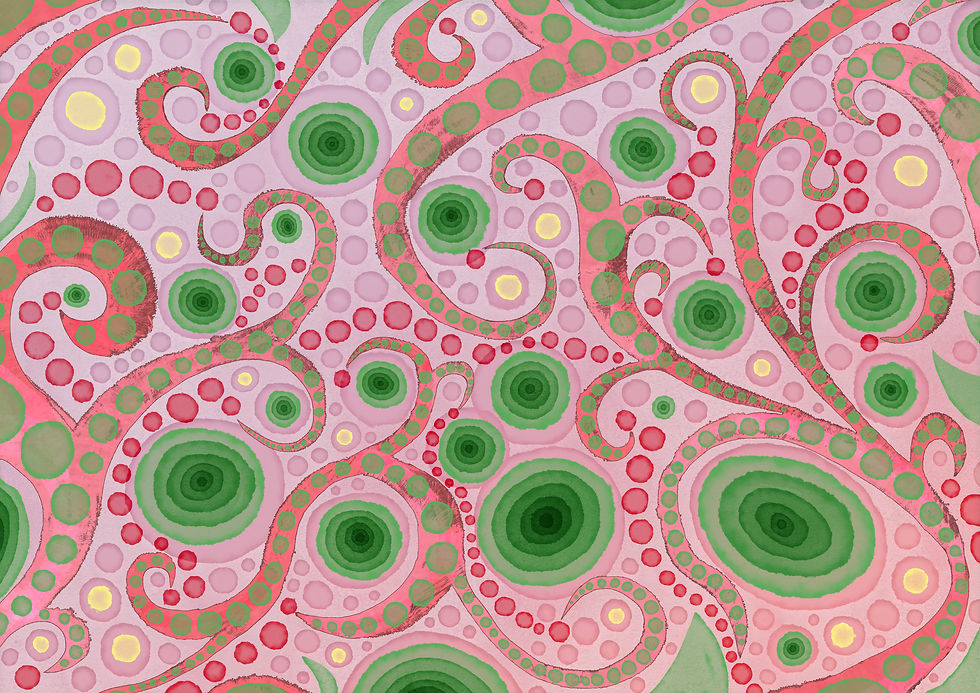
Chen’s practice borrows from contemporary theories of new materialism sensibilities, in which her use of natural imagery appears as part of a shifting ecology of relations. In addition, her digital compositions do not simply represent the natural world; through embodiment and phenomenology, they become a meditative field where perception, memory, and environment continually pass into one another. In this sense, transformation is understood less as rupture than as a continuous process of becoming. Chen’s work can be positioned within a wider field of contemporary practices that use image, color, and atmosphere to make perception itself the subject.
Know more about the artist here.
Cover Image:
Veil, 2025. Digital Painting, 30 × 40 cm. Courtesy the artist
.jpg)
Xiaoxiao Chen is an artist based between Shanghai and London. Having lived and worked across Shanghai, London, and Dubai, she draws on these diverse cultural contexts to inform her artistic perspective and visual language. Her practice explores the relationship between humans and the natural environment through abstract, layered compositions, using fluid forms and expressive colour to create rhythmic visual spaces that evoke movement and reflection. Rooted in close observation of natural phenomena and an experimental approach to image-making, her work captures shifting energies and invites contemplation.
You May Also Like

In conversation: Chen Yang
_Lauren%20Saunders.jpg)
In conversation: Lauren Saunders

In conversation: Anne Krinsky

In conversation: Dot Young