Media Platform &
Creative Studio

Magazine - Art and Culture
The Alchemy of Light and Memory: The Practice of Jiayue Wang
Joana Alarcão
Jiayue Wang's experimental photography and video works explore the image not as a fixed document, but as a living entity that continues to grow after the shutter closes. Through layered collages and dissolving cityscapes, Wang turns photographs into material encounters with time, revealing the self and the city as porous, unstable, and continually reshaped by memory, light, and place.
28 August 2026

"What interests me is what happens in that process: where a building becomes a current of water, where a document becomes something closer to weather."
In art history, the word "Nachleben" was used by Aby Warburg to describe how visual motifs, such as gestures, emotional expressions, or even drapery, endure and reappear through multiple epochs. Didi-Huberman drew on these ideas but took a step further to investigate the survival of certain images and how this is not just coincidences or curious stories but rather a symptom that they demand to be endlessly interpreted. An image does not only persist; it is a site of trauma, and an unresolved tension that haunts the present interpretation of it. Born in China, London-based contemporary artist Jiayue Wang aligns her experimental practice precisely with this interpretation. Through her layered collages and dissolving cityscapes, Wang interrogates the "afterlife" of photography, representing instability and its connection with identity and place. Wang’s two recent exhibitions, Shifting Boundaries and After the Image, investigate how images continue to drift, reconfigure, and grow after the shutter is closed, embodying the notion of images as spectral, anachronistic presences that carry memory beyond their original context.
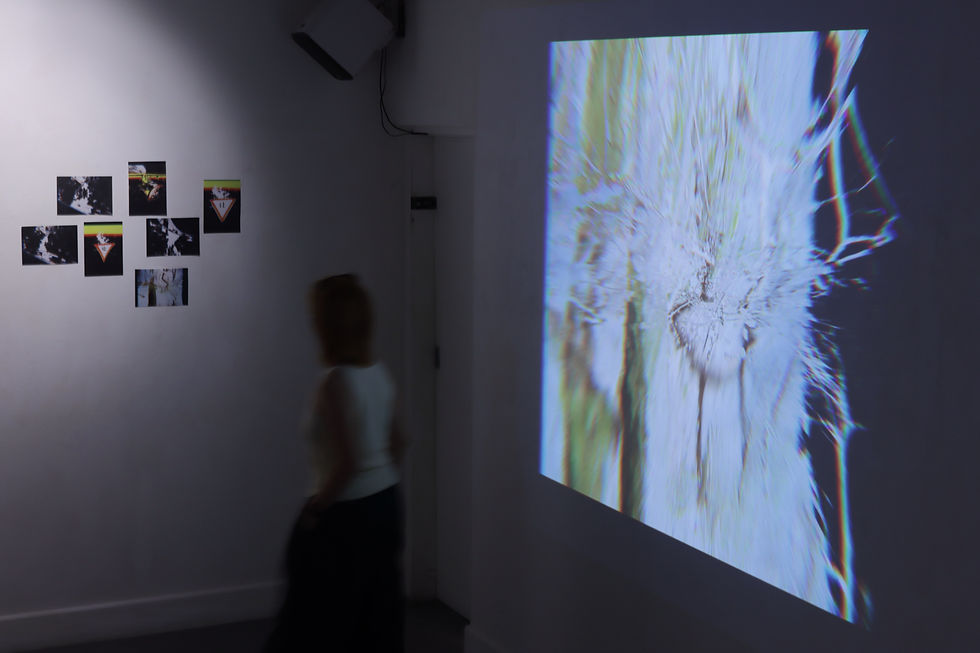
In Wang’s recent solo show, Shifting Boundaries, held on 22 July 2026 at The Photobook Café in London, the artist fuses the city with the psychological condition of the self. Through experimental photography and video, the show turns its focus on the margins of urban experience, scrutinizing neglected surfaces, architectural textures, and transitional spaces. As in Huberman’s ideas of images as phantoms that carry memory, Wang uses the city motif as a psychological force that intentionally seeks to disrupt, shape, and morph concepts and personal history. Throughout the work, the city’s continuous silhouettes are re-imagined and dissolved through slow visual transitions. Immersive soundscapes of water, ambient noise, and traffic accompany these visuals, intentionally blurring the distinction between the interior self and the physical boundaries of the city.
Wang expands this narrative from a simple atmospheric to a multisensory experience. By introducing another sense, the notion of the afterimage shifts from a purely optical phenomenon to a haptic, bodily experience, effectively making the viewer’s body part of the image’s afterlife. This is achieved materially through the artist’s collage methods; by intentionally using already-taken photos, pulling them apart, and physically layering them, the images bleed into one another. This technique moves the photograph beyond a single frozen moment, visually and conceptually transforming solid structures into currents of water, tracing a sensory transition from the solid and the surface, through the liquid, and ultimately back into light. The goal is to shift the viewer's interpretation from a fixed document to a fluid entity, challenging the notion of the self and the city and questioning how it was probably never a stable boundary to begin with.
Conceptually, this material instability mirrors identity’s instability. Drawing from Homi Bhabha’s notion of the "third space," Wang's experience of living between cultures reflects an understanding of culture not as a fixed inheritance but as a diverse and ongoing conversation. Just as photographs are seen as unstable entities, so is the self; being perceived as a porous and contingent entity. This approach aligns with artists such as Jiaxin Chen, who work with cross-mixed media, material experimentation, and photography, where their layered urban collages transform images into tactile forms by folding, interweaving, and fracturing, similarly treating the photograph as something "material, unstable, and alive." For Wang, the city is not just a backdrop but a psychological force that actively reshapes personal history, proving that material and cultural instability are two faces of the same investigation.
“I have lived between two places for most of my adult life. I don't think of this directly when I'm working, but it is there, in the way I handle images, in what I choose to keep and what I allow to go. A photograph taken in one place looks different when you are somewhere else. Memory behaves the same way.” the artist explained.

While Shifting Boundaries examined the city's psychological impact, After the Image (Wang's first solo museum exhibition, on view at the Rugby Art Gallery and Museum from 2 to 27 June 2026) turns inward to the photograph's own material mortality. The exhibition investigates the afterlife of images in a more in-depth manner, questioning the period of growth that occurs after the photograph is taken. The work exhibited asks what photography becomes when it is no longer used for representation, moving beyond the documentary record into abstraction. Here, Wang confronts Rosalind Krauss’s definition of images as an index, a trace like a fingerprint or a physical imprint of light, by dissolving the image into abstraction. As Krauss argued that photography is a direct link to reality, the artist breaks this link by making the trace unstable: the building becomes water, the document becomes weather, and evidence is no longer fixed.
The exhibition features a single-channel video work titled After the Image(2024) alongside a series of experimental photographs. Through the physical collages, deconstructed abstract visuals, and layered imagery, you can visually understand how Wang sees the image as fragility. As the building edges loosen, the colour drifts toward the corners, and the solid becomes liquid, the ideas we hold onto quietly slip away, leaving behind "afterimages" that drift across how memory was prior to the event. This is not the cultural hybridity of Bhabha's third space (explored in the previous exhibition), but a more profound instability: the instability of the medium itself, a kind of memory decay. The work aligns with artists like Priya Kambli, who physically manipulates family archives using turmeric, flour, and wallpaper to expose the fragility of memory, treating photography as a malleable, fragile object that can be obscured and recontextualized. Wang's inquiry is no longer about where the city ends and the self begins, but where the photograph ends and light begins.
Ultimately, Wang's practice asks a deceptively simple question: if photography is no longer a representation tool, what does it become? Her answer, embodied across both exhibitions, is that it becomes an environment for tracing the displacement of the world, creating a space for place, memory, culture, and medium to blend into one another and become something fundamentally different. A constant refusal of fixity. The city, the self, and the photograph are all phantom identities, meanings borrowed before becoming light. As Wang suggests, "When you step outside, the city will look a little different from before." Perhaps this is the truest form of documentation: not a series of unmoved documents, but an organic metamorphosis that continues to grow after we have looked away.
Know more about the artist's work here.
Cover Image:
View of the exhibition Shifting Boundaries, at The Photobook Café in London.
All images courtesy of Jiayue Wang.

Jiayue Wang is a London-based artist born in China. She holds a Bachelor of Arts in Media, Communication and Cultural Studies from Newcastle University and a Master of Arts in Film Studies from University College London (UCL).
Jiayue works with experimental moving image, photography, and intermedia art. Her practice is rooted in the experience of living between cultures, examining how identity, belonging, and memory are formed, unsettled, and remade across cultural boundaries. Working through physical collage, layered image-making, and spatial sound, she constructs environments where documentary and invented imagery coexist, holding open the space between what is remembered and what has already begun to disappear.
Jiayue has been developing her practice since 2019. Her work has been shown internationally across the UK, USA, China, and Greece, at venues including the Glasgow Gallery of Photography and Rugby Art Gallery and Museum, where she held her first solo museum exhibition. She has been featured in Artron.net and Visual Art Journal.
You May Also Like

In conversation: Chen Yang
_Lauren%20Saunders.jpg)
In conversation: Lauren Saunders

In conversation: Anne Krinsky

In conversation: Dot Young