Media Platform &
Creative Studio

Magazine - Art and Culture
The Emotional Geography of Migration: Devansh Soni’s Between Horizons
Joana Alarcão
A new exhibition at Gallery 40 in Brighton foregrounds questions, both intimate and expansive, about how migration reshapes our relationship with place, and how solitude, memory, and belonging travel between Gujarat and Brighton.
14 September 2026

In Between Horizons, Devansh Soni examines how migration changes the emotional conception of place, solitude, and memory. Composed largely of paired landscapes, small human subjects, and intentionally contrasting black-and-white and colour photography, the artist focuses on Gujarat and Brighton. The show foregrounds questions, both through colour and dimension, about how distant landscapes can slowly start to resemble one another when experienced by someone living between them. The exhibition proposes that migration is not only about leaving one place; it creates an ongoing state of living in transit, within identity, places, and emotional recollections.
Brighton-based Indian artist Devansh Soni is a third-generation lens-based artist and filmmaker whose body of work narrates two facets of his identity: one connected with his hometown, Ahmedabad, Gujarat, and another reflecting his current base in Brighton. However, his series does not focus only on an individual narrative but also on the collective experience of being a migrant and occupying what Homi K. Bhabha describes as a “third space”: not belonging entirely to one place or another. Through this lens, we can understand how the cultural and emotional territory produced between different landscapes can shift one’s perception. As cultures meet, an “in-between” space is created.
“Moving from Ahmedabad to Brighton for my Master’s was a big shift, and that experience of straddling two places, two ways of seeing, is really what pushes everything I make now.” The artist explains.

The exhibition can also be understood through diaspora theory. Soni’s landscapes are psychologically doubled: Brighton is never only Brighton because it is viewed through memories of Gujarat; similarly, Gujarat is revisited through the experience of having lived elsewhere. In Where Sky Meets Sea (2026), a coastal scene is filled with orange light, characteristic of sunset colours, while a lone figure stands near what appears to be a pontoon, embodying exactly this idea. The sea, the way people gather near the water, and the light are focal points within the photographs, and you can never entirely tell which landscape is connected to the real place. They are not neutral records; they are shaped by comparison, creating a loop of realities that suggests a form of double consciousness. The artist, and consequently the viewers, experience both places simultaneously.
Another way to approach the series is through Stuart Hall’s idea of diasporic identity, in which cultural identity is neither fixed nor permanent but continuously shaped by change, migration, displacement, and history. Hall’s theory helps us understand why the artist does not simply photograph India and England separately, as home is not a physical space but something continuously produced and recreated. Similarly, you can see this experience of living between cultural contexts in the work of contemporary artist Sunil Gupta, whose photography addresses migration, memory, and belonging between India and the West. Gupta’s work is relevant here as composition is a strategy to place the subject within wider social and cultural environments, showing identity as shaped by movement between places rather than existing separately from them. In comparison, Soni adopts a subtle version of this strategy: instead of using portraiture or detailed documentation to present the migrant body, the figure is reduced within expansive landscapes, making displacement visible through scale and distance.
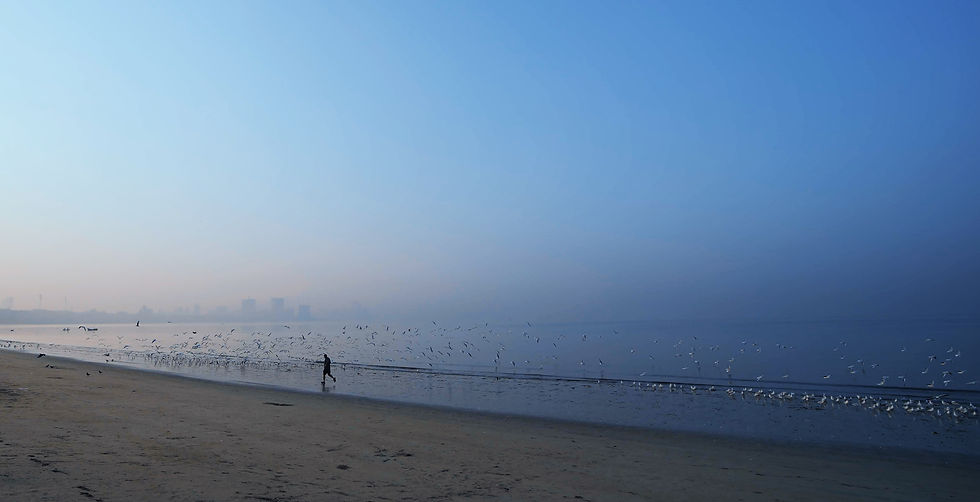
In tonal contrast, Soni plays with scale and colour to narrate the emotional terrain of both environments. Looking at the individual photographs, one can see that the figure is often placed within a small, expansive environment. In Mumbai Morning Run (2026), a lone figure, as the name suggests, runs at the beach, where you can see the semblance of buildings on the horizon, covered with fog; therefore, no identifying marks can be found. Thus, there is a certain ambiguity. A solitary person walking across a beach may visually resemble a figure crossing dry land in India, creating a sense of similarity while also drawing attention to difference; the landscapes appear connected without becoming identical.
This tension is important. The visual atmospheres of the photographs create an uncanny familiarity: the viewer may recognise the images or emotional atmospheres, but this recognition is disrupted by cultural and geographical differences. This combination suggests that very different environments can produce similar feelings.
“I kept the human figures small against very large landscapes on purpose. When someone’s tiny against a huge, empty space, it doesn’t really matter where that space is: a desert or a beach reads the same emotionally. I wanted to show that solitude isn’t tied to a specific place; it’s something that travels with you.” The artist explained in our interview.

The artist also describes his approach as observational rather than dramatically staged. Soni’s intentional use of scale makes solitude appear universal, but, by doing so, the images also remove much of the figures’ individual identity. This raises the question: is the photographer observing and recording people and places or constructing a specific emotional interpretation? Rather than examining the figures as individuals, the series moves between empathy and abstraction, inviting the viewer to identify with them despite not really being able to identify them. Thus, the photographs operate phenomenologically because they encourage the viewer to experience space rather than merely identify it. Their large-scale landscapes make solitude feel bodily and spatial: the viewer is invited to imagine being small, exposed, and temporarily suspended within the environment. Through the artist’s gaze and his wide range of scales, we can observe a broad range of emotions and perceptions.
Curiously, while this series is concerned with the emotional closeness of two geographically distant places, Soni’s use of colour sometimes separates the works as much as it connects them. Working mostly in black and white, he flattens the identifiable differences between Gujarat and Brighton, allowing a dry lakebed, a beach, or an empty horizon to become interchangeable spaces of solitude. By contrast, colour is used as a signifier. It appears in intimate human encounters, such as in The Boundless Horizon (2026), the portrait of a mother and child, where it functions less as a description than as a form of memory becoming present.

While the absence of colour represents distance and comparison, colour represents lived memory and embodiment. This distinction is conceptually persuasive, giving Soni’s work another layer. In this respect, Soni’s restraint differs sharply from that of his contemporary Raghubir Singh, whose saturated colour photographs treat colour as culturally and geographically specific, using it to register the density of Indian life rather than to dissolve difference. Soni is perhaps closer to Kalpesh Lathigra, whose Mémoire Temporelle (2016-2019) moves between black-and-white and colour to evoke an unresolved relationship with India, Britain, and the life that might have existed between them. Regardless, Soni's body of work is a medium for quiet observation, giving viewers the time and space to consider belonging, cultural identity, memory, and landscapes from the perspective of migration.
Between Horizons, presented at Gallery 40 in Brighton from 20 to 26 July, was the artist’s debut solo exhibition. The body of work will later be included in three group exhibitions this September in Brighton and London.
Find out more about the artist here.
Cover Image:
The Rathvas tribe (2026).
All images courtesy of the artist.

Devansh Soni is a third-generation lens-based artist and filmmaker based in Brighton, UK, originally from Ahmedabad, India. His practice explores memory, displacement, and identity through documentary and fine art photography. His debut solo exhibition, Between Horizons, was recently presented at Gallery 40 in Brighton, and his work is currently featured in three further group exhibitions across Brighton and London this September, including Known Terrain as part of London Design Festival 2026.
You May Also Like

In conversation: Chen Yang
_Lauren%20Saunders.jpg)
In conversation: Lauren Saunders

In conversation: Anne Krinsky

In conversation: Dot Young