Media Platform &
Creative Studio
Online Residency - Profiles
Elena Sapov
Joana Alarcão
Meet Elena Sapov, a multidisciplinary artist based in New York City, working across oil painting, photography, video, and performance.
During her January/March 2026 residency, followed by an exhibition at Filet London, she developed work that deepened her ongoing exploration of psychology, identity, and communication, where the human mind reveals itself through tension, contradiction, and inner dialogue. Treating communication as a fundamental condition of existence, Sapov translates psychological states into precise visual metaphors, giving form to what usually remains internal and unspoken.
3 June 2026

_JPG.jpg)
A multidisciplinary artist based in New York City, working in oil painting, photography, video, and performance.
Her work operates at the intersection of psychology, identity and communication — where the human mind reveals itself through tension, contradiction and inner dialogue.
She treats communication as a fundamental condition of existence.
Elena translates psychological states into precise visual metaphors — giving form to what usually remains internal and unspoken.
Her visual language is built through observation and introspection.
Artwork Description:
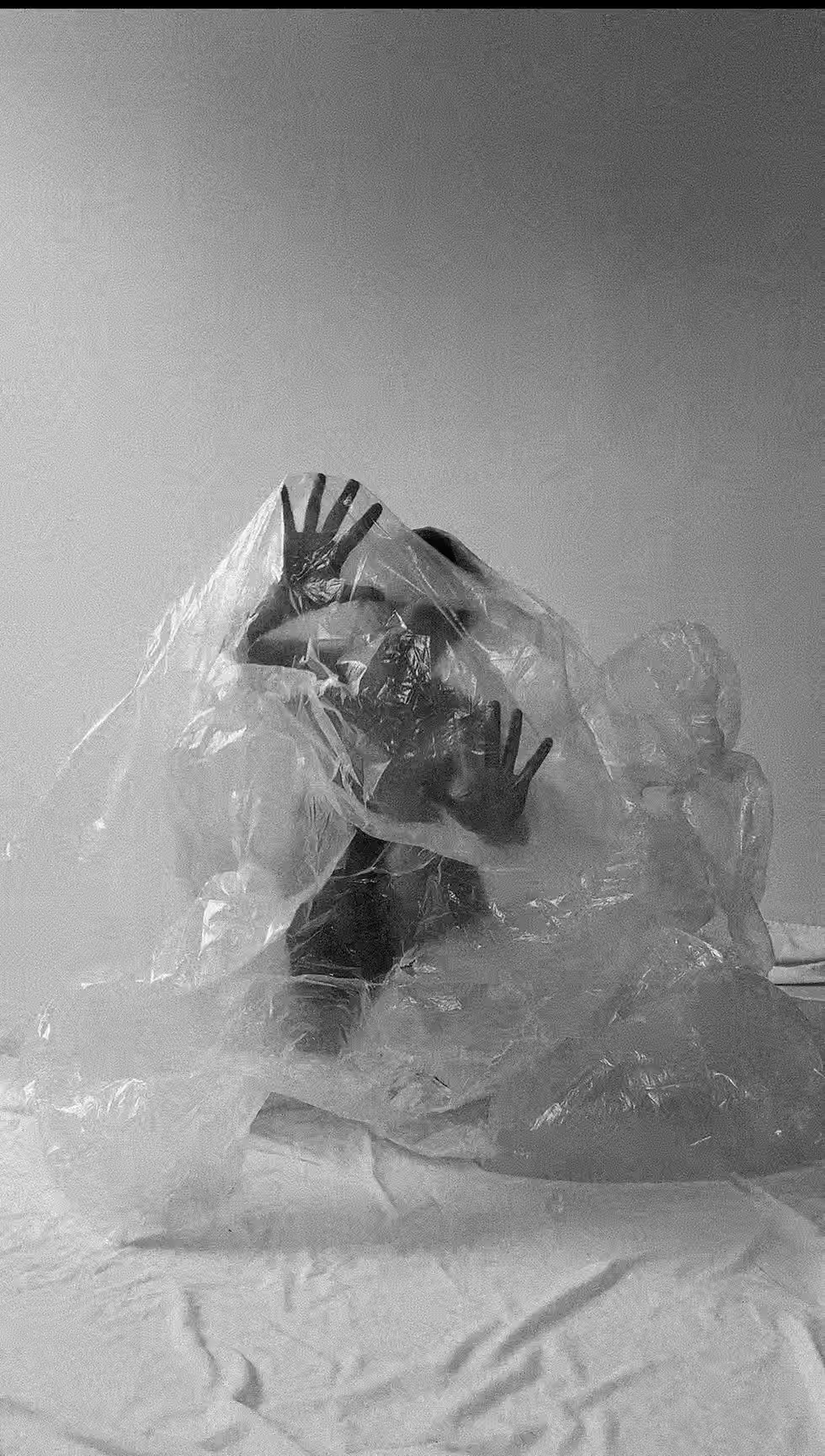
This short film presents a process of remembering that we are nature.
Contact with nature begins with contact with one’s own body — an awareness of its aliveness and its existence as a complex ecosystem.
The film unfolds through a storytelling structure composed of distinct short segments. Each part metaphorically reveals a particular stage in perception: a person experiencing dissonance within their worldview and searching for resolution.
The project invites the viewer to turn inward and reconsider the idea of separation. We cannot lose contact with nature, because we are nature in its original multiplicity — regardless of where we are or how we live.

Could you give a brief introduction of yourself and your artistic practice?
I’m Elena Sapov, a multidisciplinary artist based in New York City. My media include painting, drawing, performance, and self-portraiture. All the images I create represent an attempt to understand the nature of things. One could say that I illustrate the feelings I experience myself and observe in others.
Essentially, I feel like a kind of lens: the external world enters me, refracts internally, and emerges in the form of an image. I cannot always articulate what I am feeling, or understand why a particular phenomenon is the way it is; through my art, however, I am able to better grasp that very essence — the part that defies verbal explanation.
Consequently, composition plays a decisive role in my work, as one of the key questions I ask is: what is the nature of an object, being, or phenomenon in relation to another? And the way I arrange these elements compositionally serves as the answer.
Your practice operates at the intersection of psychology, identity and communication. How do you theoretically and visually approach this investigation?
I do this because I perceive a catastrophic lack of this understanding in the world — primarily in how we relate to ourselves.
During the residency, you worked on a film investigating what makes us part of nature, exploring the awareness of aliveness and existence. Why did you choose to delve into this theme? Could you discuss your choice of shooting locations and the visual narrative behind the film?
The choice of filming locations was quite deliberate. The first location is my art studio. Here, I wanted to emphasize the character’s sense of confinement — encased within plastic — so the setting needed to be unobtrusive and non-distracting. Next, we shift to an industrial landscape, which embodies humanity’s quest for truth — albeit a quest pursued along a false trail. This segment of the work is crucial, as it was vital for me to convey the idea that people are often simply “digging in the wrong place”; yet, their underlying aspirations are sincere — and therein lies the trap. Finally, the last location — a snow-covered forest — symbolizes the genesis of a new sensation: a sense of clarity awakening within the character — one that has not yet fully thawed, but has nonetheless stirred to life.
You treat communication as a vital aspect of life, translating psychological states through visual metaphors. Could you elaborate on how you approach this translation in your work?
I believe that everything is communication. All things- both living and non-living- came into existence through communication. Everything evolves and transforms through the medium of communication. And by this, I do not refer solely to the act of speaking. For me, it is not merely the exchange and transmission of information via speech; rather, I perceive communication as the fundamental bedrock upon which every process is built. Communication is the foundation of existence. And I have always been drawn to exploring the very core- the true nature- of things.

Can you share an example of how you and your fellow artists inspired or learned from each other during the collaborative process of the residency?
Indeed; for instance, when I hit a creative block - stuck in a loop of endlessly generating material - the entire group unanimously urged me to step away, take a walk, and reflect more deeply on the underlying concept. At every meeting, we listened intently to one another; everyone offered feedback on everyone else’s work, and there was such profound honesty in this exchange that it was impossible not to feel inspired.
The short film invites viewers to turn inward and reconsider the idea of separation. What can you tell us about your intended message?
I believe that people tend to underestimate their own true nature, constantly seeking something external, even though all true richness resides within. My aim was to inspire others to explore themselves as whole, integrated beings - to truly live the realization that we are nature. For this realization grants such a colossal insight into the nature of things that everything in one’s mind simply falls into place.
Consequently, the question of “how to regain unity with nature”, along with all the anxieties stemming from the belief that we are somehow separate from it, simply dissolves on its own. You simply begin to exist on an entirely different plane of being.

Art can be a powerful communicator and act as an agent for change. What are your thoughts on the space of art in today's atmosphere?
I consider art to be one of the most powerful forces acting upon the human psyche. This is because art communicates through subtle vibrations that penetrate directly into the depths of consciousness, bypassing the protective barriers of rational thought and social conditioning. Therefore, it is absolutely crucial for an artist to constantly cultivate their own level of self-awareness and mental clarity, so as to ensure they do no harm to others.
If you could give one piece of advice to future participants of this programme, what would it be?
My personal advice is this: do not over-analyze or over-reflect before you take action.
Find out more about the artist here.
Cover image:
Elena Sapov, 2026. 3840 x 2160. Video still. Image courtesy of the artist.

You May Also Like
.jpg)
Art in Context: Kamila Szejnoch on Site, Memory, and Public Space

The Algorithmic Gardens of Guo Cheng

Eight Meters of Silence: Bahar Talebi Najafabadi on Rejecting Didacticism in Contemporary Painting

Confronting Consensus Reality: Philip Ringler on Conceptual Photography and Cultural Critique