Media Platform &
Creative Studio
Magazine - Art and Culture
Beneath Still Waters: Caijing Kuang’s Hidden Currents of Healing
Joana Alarcão
London-based Chinese artist Caijing Kuang transforms generational trauma into spaces of quiet contemplation. The artist's monotype series, including "Growing Blue," "The Voice," and "In the Blue Hour" (recent works), disrupts traditional printmaking conventions to expose the haunting persistence of memory, layering ghostly impressions through her signature "residual buildup" technique that mirrors how trauma accumulates in consciousness. This review examines how Kuang's practice of embracing imperfection and the medium's unpredictability offers an alternative to direct therapeutic intervention, proposing instead that profound healing might emerge from the radical act of sitting with stillness amid emotional currents.
19 September 2025

“An artist’s voice may seem small, but persistence matters. By continuing to speak, we make ourselves heard, and eventually, others join in. I believe art can heighten awareness, open space for empathy, and spark both emotional and social change.”
Trauma theorist Cathy Caruth offers us a glimpse into our subconscious in her seminal work "Unclaimed Experiences," a way forward on how trauma manifests in our being and the duality of memory to create a linear narrative: "not locatable in the simple violent or original event, but rather in the way that its very unassimilated nature... returns to haunt the survivor."* This haunting characteristic of trauma embodies the visual expression of London-based illustrator and printmaker Caijing Kuang, whose rich blue monotypes embrace generational and personal trauma and transform it into a space of healing and introspection.

In our recent video conversation, Kuang reflects on the interconnection within her visual experimentation and the use of blue as a metaphor for personal and collective healing. One of the particularities of the artist's monotypes - which you can see permeated through almost her entire body of work- is not only the sense of alarming stillness but also the calm imprints of deep tones of blue. This colour choice is a very intentional decision on the artist's part, as blue has a quiet power that, like the remains of fleeting memory, appears calm on the surface while harbouring deeper life beneath. "Blue feels like an ocean," she explains, "it can be very quiet, but there's a lot happening on the deep side." The visual narratives of each work serve a dual purpose: they are a way for the artist to unravel her grandmother's recent Alzheimer's diagnosis, and they embody a sense of collective healing. The tension between the artistic process and the serene result creates a space for healing that extends beyond gallery walls.

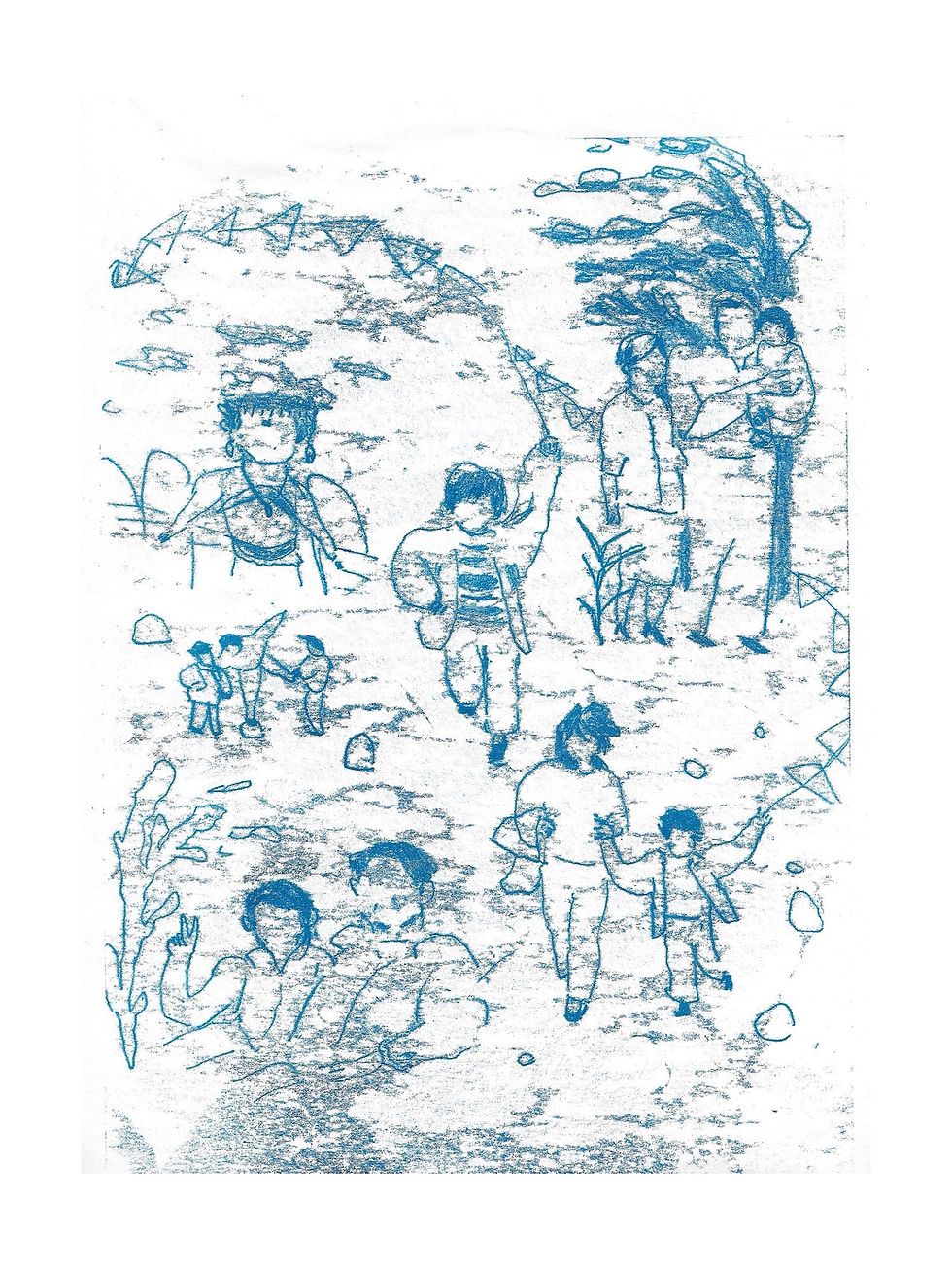
Among the series that best embody this duality are "Growing Blue," "The Voice," and "In the Blue Hour." In these works, the artist's signature "residual buildup" technique, where previous impressions ghost through subsequent prints to create layered surfaces that mirror memory's own accumulative processes, combines with blue tones and imagined monotypes of birds, human figures, and landscapes. These series are the artist's attempt to bring to the physical terrain a deep sense of loss, which she describes as "different places, different times that happen at the same time"—herself in London, her grandmother in China, a connection across geographic distance by shared temporal moments of remembering and forgetting.
Technically, conceptually, and visually, the practice of Kuang is deeply in harmony, creating a cohesive dialogue that allows for different interpretations. On a technical level, her use of blue and the deliberate decision not to clean her copper plates between prints embrace what cannot be erased. This approach is born of the medium's inherent unpredictability but also serves as a philosophical statement echoing Cathy Caruth's observations on trauma's haunting presence in our consciousness. Visually, her prints deliberately court misreading, as gallery visitors are first drawn to the surface tranquillity and beauty before recognising the underlying tension (something Kuang is actually happy with, as it gives space for healing in others). But this duality also reflects her cultural landscape of native Southwest China, where emotional expression often remains hidden beneath composed exteriors. "My friends and family say I'm the type of person who can hide emotions very well," she notes, "sometimes it looks very calm at the surface, but actually I have a lot of feelings that I didn't express."

During our conversation, we also touched on Kuang's influences, which clearly reveal a preference for imperfection over control. The artist cited Richard McGuire's Here, an artist book disguised as a graphic novel that explores a single location over time, and Swedish artist Jo Nordström's narrative techniques, but she speaks most enthusiastically about Mary Smith, whose "bold, childish, aggressive brushwork" gave her permission to abandon perfectionism. And these influences can be seen all around her work, from the medium choice to her visual narratives that chose imperfection, boldness and expression to represent the undertones of the artist's psyche.
On a larger note, Kuang's practice gives us space to sit in silence with our own thoughts, meditating on what healing means, both individually and collectively. Even more, the artist is now focusing on art's therapeutic potential, with plans to collaborate with the British Association of Art Therapists. She envisions initiatives, such as workshops and exhibitions, that might create spaces for shared storytelling. "I want to see what I can do for others," she explains, "to help them according to my experience as an artist."

Kuang's practice serves as a testament to art's potential in processing collective trauma, particularly concerning diaspora communities, displacement, and personal loss. While her monotypes may not offer a straightforward, one-size-fits-all resolution, they provide a deeper perspective, allowing us to embrace healing as a progressive journey rather than an instantaneous one. In her hands, the traditional monotype technique evolves into a contemporary meditation on resilience, transforming private suffering into collective understanding—a visual exploration of stillness amid profound emotional currents.
Learn more about the artist here.
Cover image:
Dream 02 by Caijing Kuang.
All images courtesy of Caijing Kuang.

llustrator and Printmaker.
Graduated from Kingston University.
I am inspired by random textures and love to create collages using various shapes and textures to tell stories. I like to combine different scenes to create a cohesive story, while also experimenting with various storytelling techniques.
You May Also Like

In conversation: Chen Yang
_Lauren%20Saunders.jpg)
In conversation: Lauren Saunders

In conversation: Anne Krinsky

In conversation: Dot Young