Media Platform &
Creative Studio

Magazine - Art and Culture
The Invisible Structures of Emotion and Discipline: the Practice of Huang Jie
Joana Alarcão
Whether it’s neon language, ceramic distortions, or AI-generated structures of accumulation, the artist’s forms make emotional discipline feel strangely tangible.
8 June 2026

“Many of my works come from the feeling of being shaped by invisible rules: family expectations, social judgement, repeated language, and emotional pressure. I am interested in how these forces gradually enter the body and mind and how they affect a person’s sense of identity, freedom, and self-worth.”
In Michel Foucault’s book Discipline and Punish: The Birth of the Prison (1975), the author outlines visibility as a vehicle of control, where power operates by shaping bodies and behaviour rather than by force alone. Through the lens of discipline and biopower, it becomes clear how institutions, language, and social systems regulate subjectivity, shaping behaviour and affect. Through her multidisciplinary practice, the London-based Chinese artist Huang Jie examines these structures through installation, text, and material experimentation.
In Comforting Words (2021), a video installation showing neon signs with phrases like "Don't worry", "It doesn't matter", or “Everything will be fine" foregrounds the power of language and the words we use to suppress real emotion. This installation is described by the artist as the starting point, or rather the turning point, of her body of work. Conceptually and visually, this work has a bare simplicity, maintaining a restrained visual language, where the glow of neon contrasts with the emotional emptiness of the phrases. With this, the artist exposes, unapologetically, how these "comforting" phrases simultaneously protect and discipline, suppressing genuine pain in favour of "behaving properly". Similarly, this connects with Truisms (1977-1979), by American conceptual artist Jenny Holzer, a collection of typed lists consisting of aphorisms and one-liners like "Abuse of power comes as no surprise" and "A strong sense of duty imprisons you" that sound like everyday wisdom but collectively reveal inconsistencies in social ideology. Both artists provide a perspective on how language can serve as a power structure that shapes behaviour and consciousness.
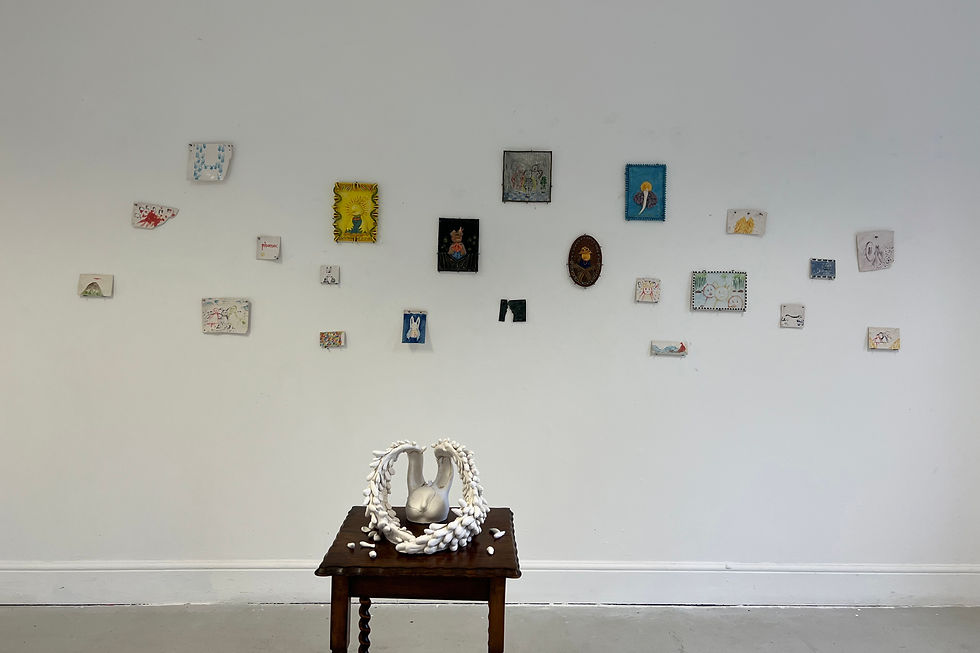
Huang, who finished her studies in Fine Art in 2024 at Kingston University, United Kingdom, has since then carved a subtle conceptual line between care and control, with a multidisciplinary practice whose work centres on the intersection of emotional regulation and familial expectations. The ceramic sculpture series Monstrous Love (2022/2023) presents this investigation connecting personal narratives with the collective experience. Within this series, the artist explores her own family dynamics and reflects on how love can become distorted over time, shifting towards forms of emotional control. A central axis of this work is the figure of the rabbit, forced to transform into a phoenix, symbolising parental expectations and emotional pressure. 'This transformation refers to traditional ideas like 'hoping sons become dragons and daughters become phoenixes', where children are expected to fulfil the dreams of their parents rather than live as themselves,' the artist explains. This piece was influenced by David Altmejd's use of fragmented figures, psychological tension, and distorted bodily forms and Lindsey Mendick’s domestic ceramic language, where humour, anxiety, and personal narrative intersect. In the same sense, Huang uses the rabbit symbol through this series of ceramic and wood pieces, playing on the tension between the domestic familiarity of ceramic and psychological unease, to create situations where these expectations can no longer remain concealed.

Huang's practice clearly connects with the architecture of subjectivity, where the self is not seen as purely autonomous but rather controlled by social structures. The artist describes her subjectivity as being shaped by specific environments (her upbringing in a Chinese family and social context that prioritised obedience, discipline, and emotional restraint) and how these external forces become internalised. Invisible Prison (2024), a project that has been selected for an upcoming exhibition running from 23 May to 6 June at Fringe Arts Bath, is the perfect example of this research. The mixed media installation, composed of a transparent rectangular acrylic box with white figures inside explores this psychological framework, hoping to answer: how do we internalise expectations so deeply that we no longer notice the walls? By using spatial restriction, light manipulation, and textual elements to visually simulate cognitive structures and social codes that construct this invisible layer, this work positions the viewer as both observer and participant.

In more recent work, the artist incorporates artificial intelligence, digital structures and compound interest to represent emotional experiences over time. Silent Interest (2026) is a web-based interactive project created with AI tools; it is the accumulation of subjectivity. By using the metaphor of a financial ledger, the work examines how small, repeated acts of restraint and self-discipline build up over time, forming durable psychological structures. Rather than staging them directly, Huang's practice exposes conditions through which they are internalised. Across her work, she reveals the unspoken rules of affective experience and the tension between a person's authentic feelings and the socialised structure of their mind, encouraging us to reflect on our identity and sense of freedom, which can unknowingly be shaped by external atmospheres.
Find more about Huang's upcoming exhibition and body of work here.
Cover image:
Invisible Prison, 2024. Model / Arcylic box. Courtesy of the artist.

Huang Jie is a multidisciplinary artist whose practice explores how emotional regulation, familial expectations, and social normalisation shape contemporary subjectivity. Her work reflects a cross-cultural sensitivity to the subtle mechanisms through which individuals are emotionally conditioned.
Working across text, installation, and material experimentation, Huang interrogates the quiet forms of coercion embedded in everyday life. Her research-driven approach draws attention to the blurred boundaries between care and control, authenticity and adaptation, visibility and erasure.
By challenging fixed emotional scripts and exploring how individuals negotiate inner life under pressure, her work invites reflection on the unspoken rules that shape affective experience in contemporary society.
You May Also Like

In conversation: Chen Yang
_Lauren%20Saunders.jpg)
In conversation: Lauren Saunders

In conversation: Anne Krinsky

In conversation: Dot Young