Media Platform &
Creative Studio

Magazine - Art and Culture
The Spatial Rhetoric of Curation: Hui Qi’s Practice
Joana Alarcão
Curating is never neutral: in Hui Qi’s practice, exhibitions become spaces where history, memory, and material presence are actively rethought.
15 May 2026

“My core work is to create an immersive speculative field through the intertwining of art and space, aiming to raise questions about identity, history, and perception to the audience, stimulate deep thinking, and explore the innovative possibilities of curating as a form of creative research and practice.”
In Ways of Curating, Hans Ulrich Obrist states, “The very idea of an exhibition is that we live in a world with each other, in which it is possible to make arrangements, associations, connections and wordless gestures and, through this mise en scène, to speak.” In other words, curation is never only about arranging artwork in a space; it is about creating ongoing conversations between place, history, and meaning. Hui Qi, a London-based Chinese curator, takes this framework seriously, turning the exhibition into a spatial and philosophical inquiry where agency, heritage, and memory are reformulated and not merely illustrated. What emerges is a curatorial language that goes beyond the aesthetic value of artworks; instead, it focuses on how narratives are remade, unsettled, or connected.

Qi’s projects in London, Paris, Shanghai, and Beijing have one thing in common: they redefine space as a narrative device in which Eastern spatial philosophy merges with Western critical theory, producing immersive environments that challenge traditional perceptions of heritage and space. One exhibition that does this particularly well is Dwelling (Lychee One, London). The curator states that this was the first time she brought “Eastern wisdom of flexible dwelling” into a Western curatorial context. Investigating the concept of “everything flows” by Heraclitus and Heidegger’s “thinking of Being” and "dwelling", the exhibition is an intersection of cross-cultural philosophies and immersive design. By questioning the traditional perception of decay and preservation, it challenges heritage and perception itself; it encourages viewers to actively approach the exhibition and treats time as something lived through space. It explores “cultural memory” through works like Qiao Xufei’s reconstructions of traditional Chinese silk patterns using ancient tempera techniques, which metaphorically represent the repetition and incorporation of cultural tradition in one’s identity. Furthermore, Qi’s landscape architectural heritage is evident in this exhibit; its immersive setting takes advantage of the "layered flows of matter, image, meaning, and memory", reflecting on the beauty of dissolution and fragmentation.

Across her larger group exhibitions, Hui Qi treats the venue itself as part of the curatorial argument, allowing architecture and history to shape the viewer’s experience. In Prism: Boundary and Unfinished Dialogues, an exhibition in partnership with Yutong Ye, held at The Handbag Factory in London in September 2025, we can see exactly that. The exhibition, an official collaboration with the London Design Festival, brought together 25 emerging international artists with works spanning oil on canvas, 3D-printed resin, laser-cut engraving, photography, and video installations. It takes advantage of The Handbag Factory’s specific architecture, as it was a former production workshop, to represent a practice that is not only theoretical but also organisational and relational.
Using the white interior, skylight illumination, and industrial history, Qi creates a curatorial narrative where the works are woven into the architecture of the space, embedding artworks directly into the “fabric” of the factory. However, the exhibition not only merges spatial narratives; it also explores how social, gendered, and geographic boundaries can evolve. It is aimed at being a speculative field where visitors are asked how they can confirm their identity in a world in constant flux. The visual language of the show moves from traditional Eastern imagery to future-oriented digital media, following a specific structure. With the prism as a central metaphor, all the exhibited works focus on the exploration of memory reconstruction, identity cognition, and spatiotemporal boundaries.

Marking a significant evolution in Hui Qi’s curatorial thread, Slow Breathing: A Gaze with Things, held at Tai Art Space in Shanghai from April 4 to 15, 2026, asks how things breathe at their own rhythm. Integrating her previous exploration of materiality and memory into a Chinese context, Qi argues that the transformation of material over time is not decay but a vital part of life itself. The project was selected as the inaugural curatorial residency for Tai Contemporary, an officially registered non-profit art institution. It challenges anthropocentrism, proposing a mode of viewing where the audience “breathes with things", moving away from traditional perspectives that treat objects merely as symbols of human emotion or concepts. One core theory of this exhibition is Object-Oriented Ontology (OOO), where objects hold their autonomy as independent and profound “beings-in-themselves,” allowing “thingness” to naturally manifest.
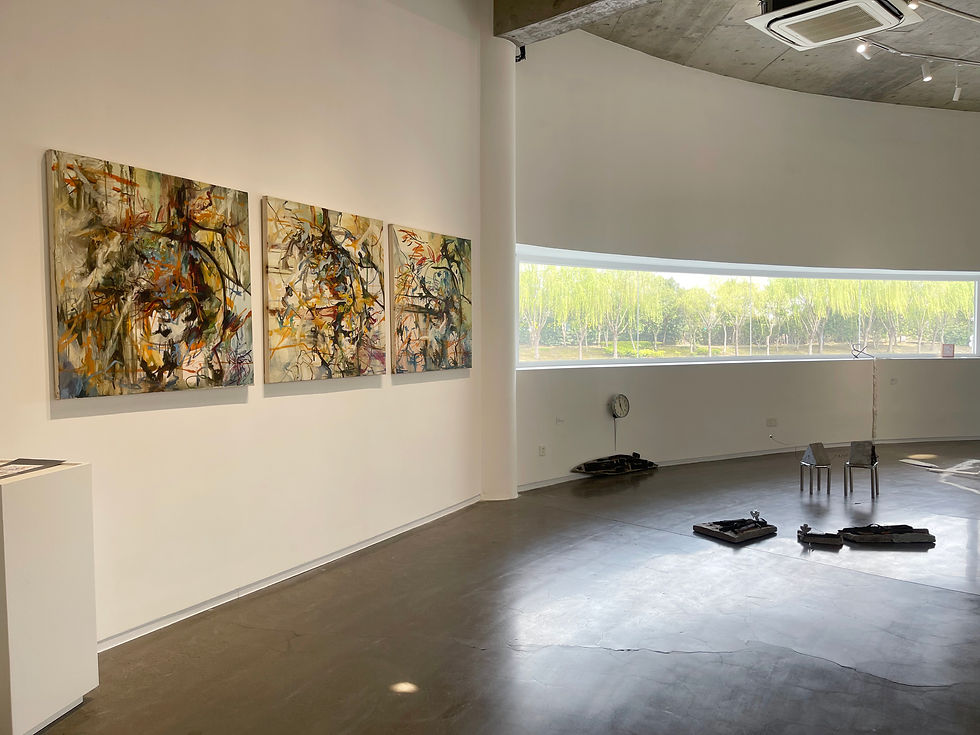
The spatial and visual experiences of this exhibition also deepened. The venue, Tai Art Space, originally a shipyard, is completely integrated into the curatorial message of the show, informing the artworks themselves. The original concrete structures and geometric forms were preserved, providing a raw industrial backdrop, yet the large window facing Yuanxiang Lake creates a constant dialogue between the interior thingness and the natural landscape. Qi described the experience as one where “rust negotiates with oxygen” and “light traces invisible rings on dust". The exhibition featured more than 20 artists working across media, including painting, photography, and installation, marking a significant evolution within the curator’s practice.
One could argue that the curating of Hui Qi is moving from heritage-as-context to heritage-as-question, redefining heritage and memory toward an expanded material intelligence. In other words, Qi’s curatorial aesthetic and approach are not only about exhibiting in historically loaded sites; she holds the space for architecture and artworks to dialogue, asking how space remembers, how objects resist fixed meanings, and how viewers inhabit time differently inside an exhibition.
Know more about the curator here.
Cover image:
Exhibition view of Slow Breathing: A Gaze with Things. Courtesy of the curator.

I am a curator, having a Master's degree in Art Gallery and MuseumStudies fromtheUniversity of Leeds and a Bachelor's degree in Landscape Architecture fromBeijingForestry University, with a solid interdisciplinary academic background. My practicefocuses on introducing contemporary art into historical sites, conducting a locallyconstructed curatorial experiment within specific spatial contexts. In this unique spatial dialogue, I continuously explore the propositions of time, memory, and individual existence, and carefully reflect on and revisit historical narratives froma post-colonial perspective. My core work is to create an immersive speculative fieldthrough the intertwining of art and space, aiming to raise questions about identity, history, and perception to the audience, stimulate deep thinking, and explore the innovative possibilities of curating as a form of creative research and practice.
In the past year, I have planned multiple exhibitions in London, including 'Dwelling(Lychee one London) and ‘Kairós:Between Choice and Fate’ (Batsford Gallery London), ‘Pathos’ (Indra Gallery London), as well as the exhibition ‘Prism: Boundary and Unfinished Dialogues’ (The Handbag Factory London) at the LondonDesign Festival. I am able to collaborate efficiently with international artists, institutions, and galleries to construct profound exhibition narratives. Project has received attention and praise from professional media, including Our Culture and 1883 Magazine. In addition, I also planned the exhibition Exposition à trois voix located at the SOL DE Paris gallery in Paris, France. I have also participated in important projects at the M WOOD Museum in Beijing, China, including RYUICHI SAKAMOTO - Seeing Sound, Hearing Time. Dancing with Xinjiang -Exhibitionof The Kizil Grottoes. The British Museum Italian Renaissance Drawings - ADialoguewith China. Man Ray - New York by day, Paris by midnight, accumulated valuable experience in contemporary art institutions in Asia.
You May Also Like

In conversation: Chen Yang
_Lauren%20Saunders.jpg)
In conversation: Lauren Saunders

In conversation: Anne Krinsky

In conversation: Dot Young