Media Platform &
Creative Studio
Magazine - Art and Culture
Thresholds of Permeability: the Practice of Lynn Pan
Joana Alarcão
Recent investigations into the blurred intersections of body and landscape inform Lynn Pan’s ongoing series, Permeation, where the dissolution of form serves as a central inquiry into female subjectivity and ecological relationality.
27 April 2026

“I am drawn to questions that feel both deeply personal and broadly human: what it means to exist as a woman, to inhabit a body and a gaze that have historically been defined by others, and how a sense of self can be constructed from the inside outward."
In The Second Sex (1949), Simone de Beauvoir wrote, “One is not born, but rather becomes, a woman,” a statement that remains a foundational way of thinking in feminist theory and art. It clearly presents subjectivity as something constructed rather than natural. Following in Beauvoir’s footsteps emerges the interplay of blurred lines and undefined structure forms of Lynn Pan’s body of work. The London-based Chinese artist, through an interdisciplinary practice, extends this line of thought visually, using the body and permeability to question how bodies, environments, and identities are drawn and redrawn.

In the series Permeation, an ongoing project that began in 2019, Pan brings this investigation to light through a series that focuses on thresholds rather than endings. The body is represented as a site where identity is negotiated and visibility can simultaneously empower and constrain; in conjunction, employing blur as a conceptual and visual form of critique, the artist suggests that the world is not a collection of separate units but rather a web of mutual permutations. Furthermore, the use of blurring within the compositions is a conscious decision that allows the viewer to make their own interpretation; it draws a line of inquiry that questions how subjectivity, ecology, and identity are drawn, maintained, and undone.
In Shell, the initial proposition of this series, a seated woman among a grass field, holds a fractured eggshell in her open palms. Here, the shell in a balance with skin (a central metaphor for the artist's practice) becomes the marker of a relationship between interior and exterior. A mundane household object is turned into a reflective beacon, asking us to meditate on permeability and exposure. This line of inquiry bears similarities to the work of Janine Antoni, as the items and imagery used are deliberately chosen to reveal another side of the mundane and home, where what is deemed irrelevant or safe can appear to be the exact opposite. Even though Antoni focuses more on using household materials in uncomfortable environments, so viewers can reconsider domestic space, Pan’s treatment of the fracture as a membrane rather than damage, it creates a connection with Antoni's visual inquiry, as it allows two worlds of interpretation, something that a normal egg would not suggest.

Extending this inquiry into a more concrete cultural terrain, Pan translates cartographic authority through a chalk grid. In Shadow, the chalk grid represents the impulse to categorise and the fundamental understanding that meanings can only become legible when neatly divided and labelled. The cultural terrain is gradually and persistently overtaken by soft, white cloud-like shadows, and these overlapping symbols transform the work from a reading of order and control into one of instability and infiltration. Continuously, the work demands a post-structural framework, one in which viewers understand the ambiguity of meaning and the idea that human culture can only be perceived through a structure that is far removed from concrete categorisations. It identifies an inevitable gap between the societal understanding of an object and the viewer’s perception of it, relying on the viewer’s own experience.
While Shadow channels a darker instability, Drift creates a soft continuity between body and landscape instead of a clean separation. In this artwork, a cow standing in a green pasture beside a stream is depicted with a focal blur, making its body dissolve into water and light. The lines between the creature and its surroundings become negotiable, suggesting a state of perpetual continuity. But in this artwork, the blur is softer and tender, as if its dissolution were an inevitable factor. In this ongoing series and its individual pieces, emotion is translated into visual narratives, relying on subtleness and restraint to hold contradictions without sentimentality.

Conceptually, Pan’s practice is clearly positioned within a feminist line of thought by exploring questions about identity that are unaligned with external expectations, especially connected with Simone de Beauvoir’s idea of woman as “the Other". Through composition that holds contradiction, Pan's practice creates a space where “female subjectivity does not need to be explained or justified but can simply exist as complex, unresolved, and fully present.” This also extends toward an ecological lens, as it insists on the interdependence of being and environment, making the images appear as studies in relation rather than portraiture or documentation alone. Engaging deeply with feminist and ecological politics, Pan challenges the idea that “containment is safety” for women and questions the mapping of ecosystems as separate species rather than interconnected webs.
Within Pan’s body of work, there is a clear refusal to create stable categories: inside and outside, self and world, and figure and environment. The work makes a provisional statement rather than reaching any absolute conclusion. It focuses on a soft documentation of shadow, water, and animals, turning them into sites where questions emerge without forced symbols or preconceived notions. This connects with the softness, intimacy, and quiet attention to ordinary things found in the visual language of Rinko Kawauchi.
The series is currently being featured in the group exhibition Water Resonates at Moon Gallery, Tokyo (2026), and is scheduled for presentation at Palazzo Pisani-Revedin in Venice later this year. Using photography and digital media, Pan explores the softening of edges and the dissolution of boundaries between bodies, surfaces, and states of being, building images where forms enter one another and structures stop being certain of their own lines. Framing these distortions as central to wider sociocultural narratives, the work points to the invisible necessity of over-categorising everything. The ambiguity and softness of the work function as signs of loss of agency, inviting us to move without fixed answers.
Read more about the artist here.
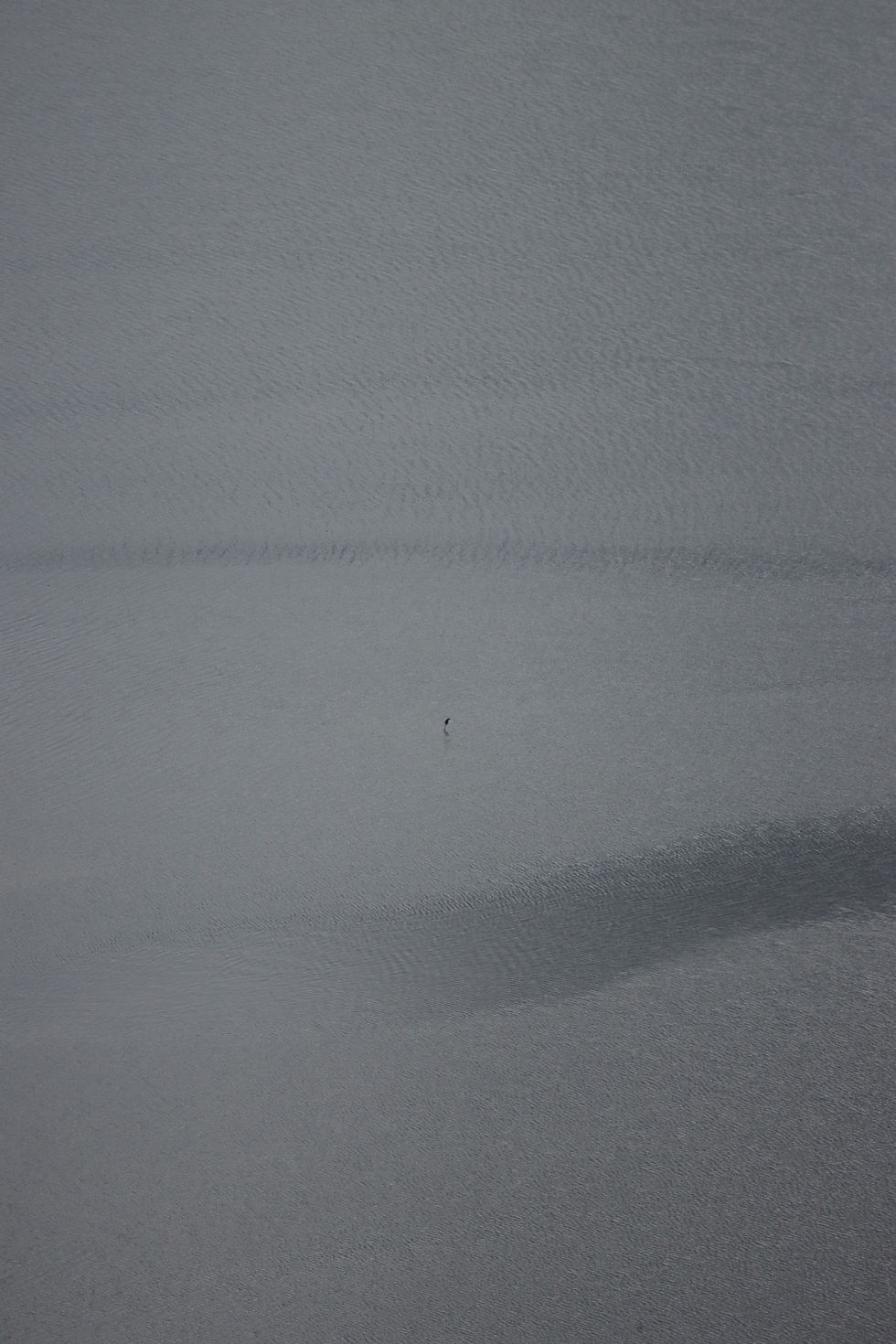
Cover image:
Bird, photography, 2026. Courtesy of the artist.

Lynn Pan is an interdisciplinary artist, through photography and digital art, she explores existential discussions on freedom and life’s meaning. She focuses on philosophical themes of female subjectivity and identity, drawing deep inspiration from Simone de Beauvoir’s ideas on “women as the ‘Other’ and subjectivity construction.” She uses symbolic, emotionally resonant visual narratives to present tensions around female emotion and self-awareness.
You May Also Like

In conversation: Chen Yang
_Lauren%20Saunders.jpg)
In conversation: Lauren Saunders

In conversation: Anne Krinsky

In conversation: Dot Young