Media Platform &
Creative Studio
Magazine - Features
A Trace of What Was: James Goodchild on Photography, Hiraeth, and the Nature of Being
Joana Alarcão
Goodchild's transformation of analogue photographic processes into a visual pursuit of an untranslatable Welsh word stops just short of resolving the very ambiguity it so carefully courts — and that, perhaps, is precisely the point.
31 March 2026

.jpg)
James Goodchild is a photographic artist, researcher, and educator whose work is centred around the philosophical implications of photography as a medium for experiencing and interpreting the landscape. Throughout his practice, he employs photography not merely as representation but as a metaphorical lens through which he explores ontological questions surrounding presence and perception. His work invites viewers to engage with landscapes in a deeply personal manner, encouraging a reflexive relationship between the observer and the observed. His ongoing research continues to push the boundaries of how we perceive and embody our surroundings, making significant contributions to both the fields of photography and contemporary art studies. He is currently studying for a practice-led PhD at the University of Leeds.
Postgraduate Practice-Led Researcher, PhD, University of Leeds, School of Fine Art, History of Art and Cultural Studies.
“Within my practice, the very act of photographing becomes an inquiry into the nature of being.” Each exposure is both a record of presence and an exploration of absence, a trace of what is, what was, and perhaps what might never have been.”
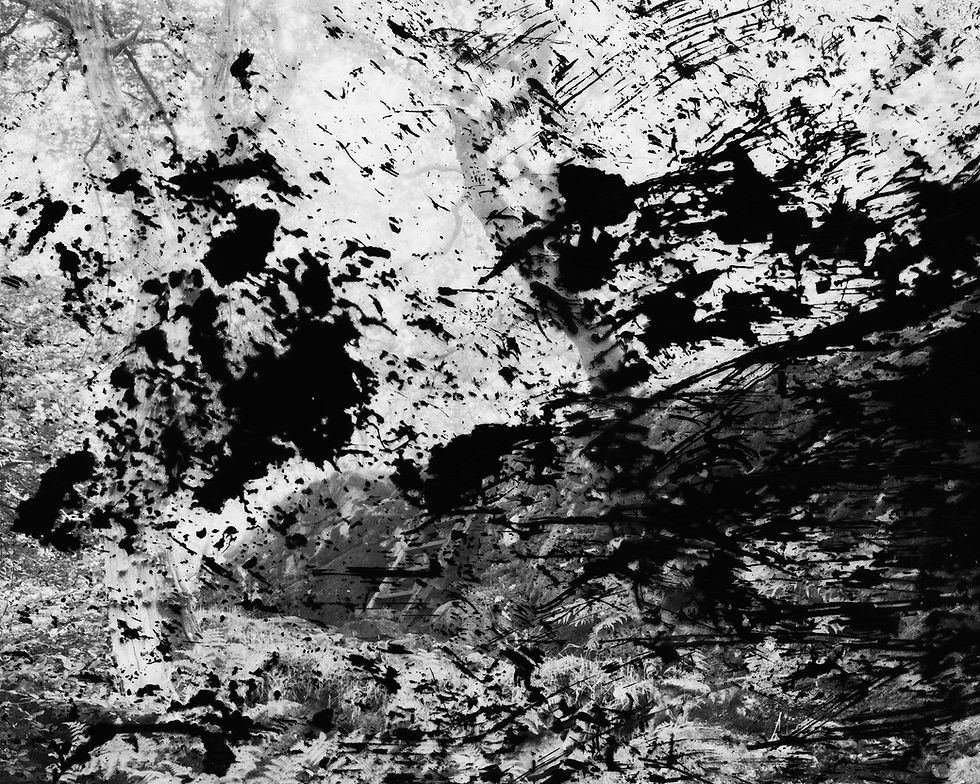
James Goodchild visually communicates what linguistics cannot. For over two decades, he has dedicated his artistic research to expressing, through photography, the feeling evoked by the Welsh word "hiraeth", a deep sense of longing. With a collection of abstract photographs of Welsh landscapes, his work seeks to question rather than attribute meanings, focusing more on the emotional impact of the work. Goodchild's visual narratives rely on the somatic quality of photography, letting images become interactions with place, and underneath the cloak of a photographic language lies a remembrance of what it can signify for audiences and the artist themselves. Although the artist began his artistic investigation through the documentation of landscapes, his recent abstract artworks inquire into the nature of being, continuously questioning our relationship to time and presence and the act of looking.
In recent works, this abstraction has come further to the fore, where the open interpretation method of the medium is similar to the concepts investigated. Following his initial resolution that landscape semiotics were insufficient to represent and capture hiraeth, his body of work became a visual and conceptual symbiosis. The material, mediums, light, and landscape started to play a role in the creation of the artworks. Images started to be exposed to natural light within the landscape, making a conscious decision to do an act of destruction, breaking the traditional photography iconography to vinculate concept and reference. Contemporarily, Goodchild’s practice bears a similarity with the practice of Awoiska van der Molen, where light exists through darkness, as she creates a collection of monochromatic photography that penetrates the landscape in which she photographs, giving the audience a strong sense of embodied "being there", which mirrors his own existential engagement with place.
Most importantly, Goodchild’s practice is an act of viewing the artwork both as the artist and the audience, a more participatory quality, where ambiguity gives spaces for open-ended interpretation, becoming not only a conduit of the subject itself but also of the nature of seeing and representation.
Could you start by telling us a bit about what steps you took to become the photographic artist, researcher, and educator you are today?
After initially studying history at university, I travelled around Europe, perhaps unsure of the next steps in my life. Whilst in Brugge, Belgium, I stumbled across a photographic documentary series about Cuban refugees attempting to cross over to Florida; those powerful images have had an impact on me that has never left. From that point onwards, I decided to become a photographer and enrolled in another undergraduate course when I returned to the U.K. and have never looked back. Although my practice has evolved into something quite different from that of documentary photography, I still aim to share, through my own photography or through education, the power of the medium and the passion I found in that exhibit in Brugge on that fateful day.
In your practice, your area of research focuses on the Welsh word, Hiraeth that signifies a longing for home that runs deeper than homesickness. What made you want to dedicate your practice to translating this feeling into visual language?
Tackling what is inevitably a linguistic issue via a visual medium has always been a point of discussion throughout my research and practice. Photography is a form of visual communication with a long history of conveying meaning through imagery. Within the field of semiotics, photographs act as the signifier and the concept as the signified; photography is as valid as any other form of enquiry, especially, I believe, when dealing with hiraeth. Photography is an enhanced way of looking and, consequently, a way of knowing in which we engage with the perceptual and embodied processes underlying thinking. Emotional and personal concerns often drive research in the creative arts; it operates not only on explicit and exact knowledge but also on tacit knowledge. Wales is also a bilingual country; the history of Wales and the Welsh language has been turbulent at times. I also struggled with language when I was young, growing up in Wales, but it wasn’t until I discovered photography that I found my own language, which doesn’t have to be translated from one language to another. This makes photography the perfect method of inquiry to translate the hiraeth so that anyone, regardless of language, could start to engage with the notions that hiraeth conveys.

Your current photographic series is a conversation with the landscape, a process of shaping each image through direct, physical interaction with place. Can you walk us through your creative process and how you shape your visual interpretations of place?
Within my practice, the very act of photographing becomes an inquiry into the nature of being. Each exposure is both a record of presence and an exploration of absence, a trace of what is, what was, and perhaps what might never have been. I have used a range of techniques and processes throughout my practice, unified by having a direct physical relationship to the continuous pattern of light cast by the sun whilst in the location of my research, claiming an existential connection, no matter how vague, to what has and does exist. Photography is a medium of time, a continuous signal, and a continuation beyond the image capture; my work invites viewers to question their own relationship to presence, time, and the act of looking. Hiraeth is an ambiguous and ineffable word, and because of this, and the methods I employ, the images have become quite abstract. This abstraction leads to an open interpretation, similar to hiraeth itself, yet the photographs retain an indexical link to the image's referent, which cannot be denied given the materiality of analogue photography.
Could you discuss a particular artwork from the collection that you regard as especially powerful and that cogently exemplifies your conceptual research?
The images that undergo various processes of abstraction have proven to be the strongest expressions of hiraeth. The lengths I go to in order to make the initial photographic capture with a large-format camera in the mountainous region of Wales, only to then do what to most would see as an act of destruction, has, in a way, given my work the most life. Breaking the photograph's iconography has strengthened its indexical relationship to the referent. It is not only the abstract images that this process creates, but the process itself exemplifies the research through my chosen medium.

In our previous conversation, we talked about your ongoing research and how your search for articulating the ever-changing quality of hiraeth will never be completely done. How do you feel your interpretation of the work has changed since the start of this research? How do you feel the audience interacts with it?
As a photographer, and especially within this project, the artwork is composed of a series of images rather than individual pieces. The project contains multiple processes and experiments, some of which have worked, and others that have not. In my earliest work, I established that the landscape semiotics captured within my photographs are not enough to represent hiraeth. I realised that the visual and the conceptual must be symbiotic, and from this idea I started a series of experiments in which, using the material qualities of photography, a print or negative was made to engage with the landscape directly. This has been the biggest change since the start of the research, and I am still exploring new processes and techniques.
I see the act of viewing as an active, participatory process rather than a passive one. Intentionally leaving certain elements ambiguous or open-ended, I encourage the audience to bring their own experiences and interpretations to the image. This, I believe, is especially important when dealing with hiraeth. My aim is to create a space for dialogue between the artwork and the observer, prompting reflection not only on the subject depicted but also on the very nature of seeing and representation.
For you, photography serves as a language to connect with the world, but you were quite frustrated with it as a medium, which made you switch to a more abstract personal and collective interpretation of the landscape and place. Can you lead us through this transition?
My approach to making images has become more interpretive and experimental. Rather than attempting to create a perfect photographic representation, the act of photographing has, over time, become an act of exploration, with the aim of pushing the boundaries of what can be conveyed through visual language. This often leads to abstract images, transforming photography into a method of enquiry that does not offer a final statement but considers multiple perspectives and possibilities. It was upon discovering this way of working that I felt I was getting closer to my goal, even though I know it will never be fully achieved. Acknowledging photography's weaknesses as well as its strengths has also helped push the practice further and has led to much questioning about what a photograph can and cannot represent.

For over two decades, you have worked in photography and the creative arts through exhibition, teaching, and building collaborative partnerships with artists and institutions. What have these two decades taught you about the creative field? What advice would you share with artists in the early stages of their careers?
My advice would be that passion is the most vital attribute to possess. Passion for both your chosen medium and subject matter is key to maintaining involvement within the creative industries. Although it can be very difficult, you need to find your own voice and mode of expression without being swayed by what is currently deemed to be successful, whilst at the same time engaging with the work of others. In a way, it has taken me twenty years to get to that point, and now I feel I am at the beginning of a new chapter within my own work and my identity as an artist. People now more than ever want to be successful, but success, like life, is fleeting, so aim to be fulfilled by your own work first and enjoy the journey.
Do you have any upcoming exhibitions or projects where the readers can maybe see your work?
My work has recently been on the front cover of Collect Art Magazine, and within that magazine can be found another interview of my work and images. Work from the Hiraeth series has also been recently on display at the Dark Peak Photography Festival, which, although it has now ended, still has an online presence. The aim of the Hiraeth project is to exhibit first and foremost in Wales, which I plan to commence in 2027 onwards, and details of which I will post on my social media account.

From your perspective, how do art and artistic creation bridge the gap between global societal and political issues and the general public?
Art is well-positioned to engage with and raise these issues in ways that other media cannot. Art, I believe, is not only there to begin and encourage conversations around these issues but also to help educate people about them. In an age of fake news and artificial intelligence, the physicality of original art has become even more important, helping us go beyond the ever-increasing virtual lives we inhabit, providing an alternative. This alternative is not only for existing audiences but also, perhaps more importantly, for new audiences. Art is international; it travels beyond borders, it might at times divide opinion, but it can ultimately unite us.
Lastly, what message would you like to leave our readers?
Art is not a universal remedy, yet it often provides the most fitting means of exploring and engaging with complex questions. Through art, ideas take tangible form, becoming surfaces that invite sensory engagement. The photographic print, as an object, becomes a vessel for meaning. In my practice, I strive to evoke the essence of hiraeth through these objects. Through this, I hope to contribute to a shared cultural understanding, offering new ways of contemplating and connecting with this deeply rooted sense of longing for a place.
Know more about the artist here.
Cover image:
Hiraeth #1, Giclée Print, 40cm X 35cm, 2024. By James Goodchild.
All images courtesy of James Goodchild.

You May Also Like

In conversation: Chen Yang
_Lauren%20Saunders.jpg)
In conversation: Lauren Saunders

In conversation: Anne Krinsky

In conversation: Dot Young