Media Platform &
Creative Studio
Magazine - Features
Debris and Restoration: Laura Bernardeschi Nelson's Material Ecology
Joana Alarcão
What does climate crisis feel like as texture? Laura Bernardeschi Nelson's mixed-media assemblages answer through material: beach debris, fishing nets, seaweed transformed into what she calls 'physical archives of environmental harm'—art that witnesses through its very substance.
15 December 2025

As an artist deeply rooted in ecological values, my practice explores the intersection between art, nature, and sustainability. I work primarily with acrylics, oil pastels, and mixed media, often incorporating found and repurposed objects into my canvases and installations. Items such as old clothes, scarves, jewellery, CDs, coins, teapots, and even a discarded bicycle become part of my visual language. I believe in giving new life to forgotten things—transforming the ordinary into the meaningful. Recycling in art is not just a technique; it is a quiet act of resistance and hope.
My creative journey extends beyond the studio. I am the author of Mixed Media and Climate Awareness: Laura’s Impactful Art (2025), a book that reflects my artistic response to climate change and the importance of sustainable creativity. This work is a personal manifesto, urging both artists and audiences to reimagine how we engage with the environment through art.
Recently, I completed my first outdoor art installation in my garden in Newcastle upon Tyne, using these found objects to create a space where nature and art blend seamlessly. It is a living installation where recycled materials breathe alongside plants, reminding us that beauty and meaning can be found in what we often overlook.
Through my work, I hope to invite reflection, spark conversation, and gently remind us that everything is connected. Artists have the power—and the duty—to inspire a deeper awareness of our world and to help nurture a more conscious, compassionate relationship with the Earth.
“Beyond materials and methods, art sparks reflection and dialogue—it can challenge perceptions, evoke empathy, and inspire behavioral change”.
A seaweed embedded in acrylic and gesso, its textural and parched surface reminds one of the sea, alongside the familiar plastic and rugged texture of fishnet and its rope. In Laura Bernardeschi Nelson’s mixed-media work DEBRIS OF OUR OWN MAKING (2025), found objects and natural materials create a visual tension and symbiosis between human-made objects and the textures of the natural world, framing the dialogue between two spectra of our contemporary world. The textured path running through the composition—built from canvas, wallpaper, gesso, North Sea sand, acrylics, parcel paper, real seaweed, rope, fishing nets, and even a spray-painted can—invites viewers to ask: What story do we wish to tell about our role in environmental degradation?
This artwork is part of Laura Bernardeschi Nelson’s new body of work, where material ecology and emotional urgency intersect to transform mixed-media and acrylic work that integrates fishing nets, seaweed, plastic waste, and other discarded materials collected from North Sea beaches, into a "physical archives of environmental harm." This conceptual and visual framework places her within a broader lineage of assemblage and eco-art, resembling Robert Rauschenberg’s Combines, which used found materials to blur the lines between art and everyday life and Arte Povera’s material strategies that challenged artistic hierarchies. However, Nelson’s practice extends to recontextualise this heritage towards twenty-first-century environmental discourse.
This new collection of work steps away from her early creations that featured bold, vibrant female figures seen in HEART OF THE COSMOS (2025) and POP ART, focusing more on personal healing and environmental activism that emerged after what Nelson describes as "a challenging year marked by mental health struggles." However, her turn toward "soft, peaceful landscapes" still carries heavy conceptual weight. In both DEBRIS OF OUR OWN MAKING (2025) and SCARS OF THE GREEN PLANET (2025), the artist uses found objects, rich textures, and expressive lines to establish visual tension that is both beautiful and disturbing, weaving a pathway towards embodied engagement with the urgent consequences of climate change.
Framed within the contemporary lines of artists such as Nnenna Okoren and Aurora Robson’s discarded plastic sculptures, Nelson's work operates in a space where materials and textures are specifically representative of certain beaches. By doing so, she brings forward an aesthetic that not only highlights these sites but also emphasises the impact of the environmental crisis, developing a body of work that does not simply represent these issues but materially engages with them, transforming waste into a space for reflection.
With an upcoming solo exhibition on climate change and her recent publication Mixed Media and Climate Awareness: Laura’s Impactful Art (2025), Nelson continues to expand what she calls "the dialogue between personal creativity and collective responsibility." The question her work poses is not whether we need to use art for climate awareness in a time of constant acceleration, but whether we can afford not to do so.

Can you start by giving us an overview of your practice? What conceptual and visual frameworks encompass your body of work?
My practice is rooted in exploring the intersections between memory, identity, and the natural environment. I work primarily in mixed media, acrylics, combining painting, oil pastels, and found materials to create layered, tactile surfaces that invite viewers to experience both intimacy and expansiveness in my work. Over time, my practice has evolved to address environmental concerns, reflecting a commitment to raising awareness about climate change and the human impact on ecosystems.
Conceptually, my work is anchored in self-exploration and social commentary. Visually, my practice embraces layered textures, vibrant and sometimes unexpected color palettes, and a tension between abstraction and figuration. I often juxtapose delicate, ephemeral materials with more permanent media to echo the fragility and resilience inherent in both personal experience and the natural world.
At its core, my work seeks to create an emotional dialogue with the viewer, balancing aesthetic impact with thought-provoking content. By integrating personal storytelling with environmental advocacy, I aim to challenge perceptions and encourage reflection on the interconnectedness of our inner and outer worlds.
At the beginning of your artistic journey, you portrayed female figures, but recently you shifted your focus toward soft, peaceful landscapes. What prompted that shift?
After a challenging year marked by mental health struggles, I found myself seeking a sense of calm and stability in my work. Earlier in my career, I focused on female figures, often rendered in bold, vibrant colors, which reflected energy and intensity. But I realized I needed a shift—a move toward creating something restorative, both for myself and for those who experience my work. This led me to soft, peaceful landscapes, where muted tones and gentle forms provide a space for reflection and serenity. It was a conscious choice to step away from the intensity of bright colors and figure-focused work, embracing a quieter, more meditative approach that helps me—and hopefully my audience—find a sense of peace.

In our recent conversation, you mentioned that the three-dimensionality and found objects in your work carry significant meaning for viewers. Could you elaborate on this concept and provide a specific example?
The three-dimensionality and use of found objects in my work are essential for creating a tactile, immersive experience that conveys both visual and conceptual depth. At this stage in my practice, I am focusing on climate change and the fragility of our oceans. I often recycle materials like plastic, rubber, or seaweed collected from the beaches of the North Sea, intertwining them with discarded fishing nets to reflect the impact of human activity on marine ecosystems.
A specific example is my recent piece, Debris of Our Own Making.
In this mixed-media work, I combine canvas with wallpaper, gesso, North Sea sand, acrylics, parcel paper, real seaweed, rope, fishing nets, and even a spray-painted can. The piece merges natural and man-made debris, creating a textured seascape that shifts between beauty and disturbance. The translucent “fish bellies” made from parcel paper evoke marine life washed ashore, while the dark spray-painted can stands as a stark symbol of pollution. By integrating these materials directly into the work, the canvas becomes a physical archive of environmental harm, encouraging viewers to engage with the tangible consequences of human activity and the urgent need to care for our oceans

Presently, you are developing a painting project that critically examines the theme of deforestation. What are the conceptual frameworks of this project? How do you feel it encapsulates what your work is about?
My current project on deforestation is built around a clear and urgent conceptual framework: to communicate the critical need to protect our planet before it’s too late. Through this work, I aim to make the environmental crisis tangible, confronting viewers with the consequences of human negligence and the fragility of our ecosystems.
A recent example is my piece Scars of the Green Planet, created with oil pastels on paper. In this work, fiery tones rise in the distance while the remnants of once-living trees stand as silent witnesses to destruction. Swirling blues suggest both water and smoke—elements that should sustain life, now caught in turmoil. The rich textures and expressive lines convey tension between life and loss, encouraging reflection on how collective actions leave deep, sometimes irreversible marks on the natural world.
This project encapsulates the essence of my practice: blending emotional resonance with environmental advocacy. By creating works that are both visually compelling and conceptually urgent, I hope to inspire awareness and action, offering viewers not only a reflection of our current reality but also a call to care for the planet we all share.

In this mixed-media piece, Pop Art, you blend painting with real-life objects to explore themes of identity, aging, and emotional resilience. What inspired you to create this work? What message do you feel this work portrays to its audiences?
Pop Art was inspired by my desire to explore the intersections of identity, aging, and emotional resilience, particularly in relation to women’s experiences. I wanted to create a work that was tactile and immediate, blending painting with real-life objects like a bra and necklace to give the piece both physical and symbolic weight. These objects serve as markers of personal history, femininity, and the complex narratives women carry.
The faceless figure, surrounded by affirmations like “RESPECT,” “STRENGTH,” “AGING,” and “MENTAL HEALTH,” reflects my core philosophy: centering women’s visibility, empowerment, and well-being. By combining vibrant colors, textures, and text, the work communicates a balance of vulnerability and strength, encouraging viewers to reflect on their own experiences and relationships with identity and resilience.
Overall, the piece sends a message of affirmation and recognition—it’s both a celebration of women’s journeys and a call to acknowledge the emotional layers that shape us all.
Recently, you created a mural in North Gosforth, bringing color and creativity to the community. What conceptual and visual elements that underpinned this piece?
The mural I created in North Gosforth was a way to express my creativity and my love for art, independent of whether everyone in the neighborhood appreciates it. I wanted to create something vibrant and personal, a reflection of who I am as an artist, and I’m happy with the piece regardless of external opinions.
Moving from Bristol, where I lived for three years, to Newcastle was a big change, but the experience reinforced the importance of endurance and adapting to a new way of life. Interestingly, the mural has already started to spark responses from neighbors—a festive painted Grinch appeared on the windows of one veranda last week, and others stop to admire the work in front of my garage. This interaction reminds me of how art can create subtle connections within a community, even unexpectedly. I’m already planning a new mural for this spring, continuing this dialogue of creativity and engagement.
You mentioned that a core aim of your projects is to invite reflection, spark conversation, and gently remind us that everything is connected. What has been the audience's reaction to this approach so far?
The impact of this approach is steadily growing, and I’m truly glad that people recognize me as an artist who is committed to her audience. While I create art primarily for myself, I also aim to leave a message for the world—whether that’s raising awareness about the environment, mental health, or the interconnectedness of life. I’ve seen audiences pause, reflect, and sometimes even engage in conversation inspired by my work, which is incredibly rewarding. It reinforces my belief that art can be both personal and universal: it carries the imprint of the artist’s own journey while inviting viewers to explore their own thoughts and emotions.

I would also like to discuss your work beyond the studio. You are the author of Mixed Media and Climate Awareness: Laura’s Impactful Art (2025), a book that reflects your artistic response to climate change and the importance of sustainable creativity. Can you tell us a bit about it?
Mixed Media and Climate Awareness: Laura’s Impactful Art (2025) is both a practical guide and a reflective exploration of how art can respond to urgent environmental issues. The book demonstrates how mixed media techniques—painting, collage, and the incorporation of found or recycled materials—can be used to raise awareness about climate change, turning creative practice into a form of advocacy.
It highlights projects that transform discarded objects, natural elements, and everyday materials into visually compelling artworks, illustrating how sustainability and artistry can coexist. Beyond technical guidance, the book shares my philosophy that art should carry meaning: it is a way to spark reflection, provoke dialogue, and leave a message for the world. Readers are invited to explore the connection between personal creativity and collective responsibility, learning not only new artistic approaches but also ways to engage thoughtfully with the environment through their work.
In short, the book is both an artistic toolkit and a call to action: a celebration of creativity that carries a deeper purpose, inspiring artists and audiences alike to consider how their work can contribute to a more sustainable future.
Art and artists play various roles in the fabric of contemporary society. How do you see artistic practices advancing sustainability and social consciousness?
Artistic practices have a powerful role in advancing sustainability and social consciousness. Many artists, especially younger generations, are using their work to address climate change, environmental degradation, and social issues, turning creativity into a tool for awareness and action. By integrating recycled materials, sustainable techniques, and environmentally themed projects, artists can model more responsible ways of engaging with the world.
Beyond materials and methods, art sparks reflection and dialogue—it can challenge perceptions, evoke empathy, and inspire behavioral change. In this way, artists contribute not only aesthetically but also ethically, encouraging audiences to consider their impact on the planet and on society. I see my own work as part of this broader movement: creating visually compelling pieces that also carry urgent messages about environmental stewardship and collective responsibility.
What message or call to action would you like to share with our readers?
My message to readers is simple but urgent: we must act to save the planet before it’s too late. Through my work, I hope to raise awareness about climate change and inspire reflection on how our everyday choices impact the environment. Art can be a powerful catalyst for change—it invites people to pause, think, and engage with issues that affect all of us.
Looking ahead, I’m planning a solo exhibition on climate change for next year, where I hope to expand this dialogue and create an immersive experience that encourages audiences to consider their role in protecting the Earth.

The Choice is a powerful mixed media artwork reflecting the delicate moment humanity is living through in the era of climate change. Painted in acrylics and enriched with natural and reclaimed materials such as beach sand, dried flowers, and an old CD, the piece becomes both a visual statement and a physical reminder of the world we are reshaping.
The composition is divided in two paths:
On the left, a hand holds a lighter, flames rising from the fingers. The trees are charred, symbolising destruction, deforestation, and the ongoing environmental damage driven by human behaviour.
On the right, another hand presents a flower. Here, tender green leaves begin to return, reminding us that regeneration and healing are possible if we choose differently.
At the centre sits a circular relief created from an old CD, representing Mother Nature. Her gaze is calm but watchful, observing humanity’s decisions without anger — offering us responsibility, not punishment. The circular form suggests the cycle of life, and that the future is still unwritten.
The textured path running through the forest invites the viewer to reflect on their own direction — a personal and collective journey where the decisions of today will determine what remains tomorrow.
This artwork blends expressive brushwork with tactile elements, making it both visually and emotionally engaging. It is a piece that speaks to everyone concerned with our planet’s future and the fragile balance between loss and hope.
Know more about the artist here.
Cover image:
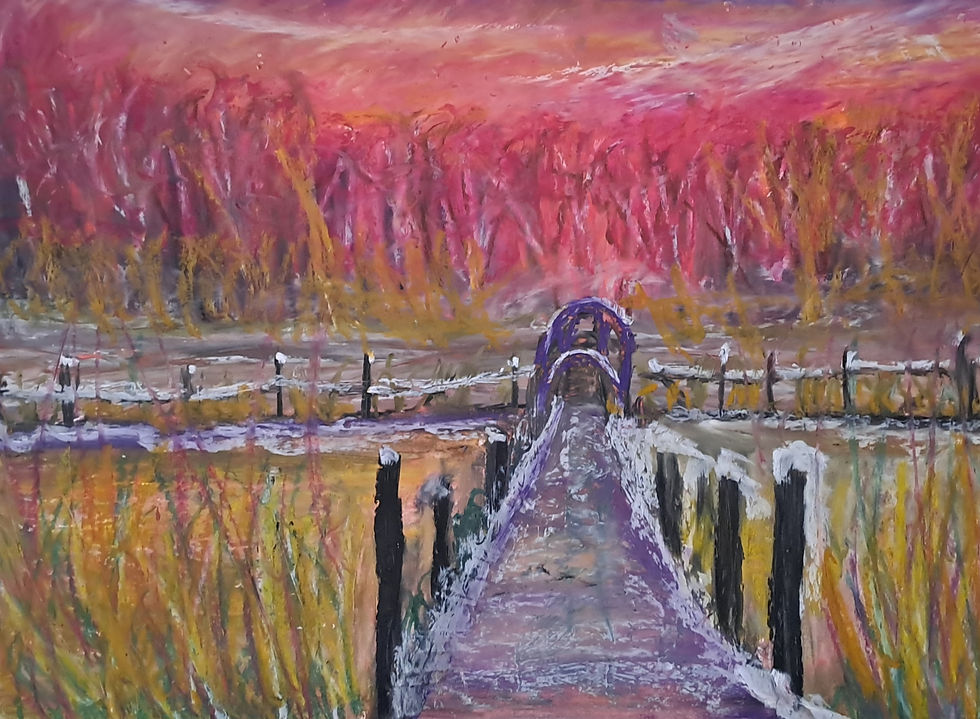
Northumberland Evening Glow. Mixed media on paper, 45 x 35 cm. By Laura Bernardeschi Nelson
All images courtesy of Laura Bernardeschi Nelson.

You May Also Like

In conversation: Chen Yang
_Lauren%20Saunders.jpg)
In conversation: Lauren Saunders

In conversation: Anne Krinsky

In conversation: Dot Young