Media Platform &
Creative Studio
Online Residency - Profiles
Marina Remova
Joana Alarcão
Meet Marina Remova, a multidisciplinary artist whose research-based practice explores the intersections of art, ecology, and science through the lens of collaboration and systems thinking.
Originally from Moscow and shaped by a nomadic, cross-cultural trajectory, Marina brings a background in partnership facilitation and sustainability into her artistic work. During her January/March 2026 residency, followed by an exhibition at Filet London, she developed a series of experimental pieces engaging mycelium as a co-creative agent. Combining organic and industrial materials, such as paper, textile, metal, and mirror, her works investigate dialogue, uncertainty, and the invisible networks that connect human and non-human systems. Rather than treating mycelium as a passive material, Marina positions it as an active collaborator, allowing its unpredictable growth to shape each piece and reveal alternative models of coexistence.
14 May 2026



After working across international business operations in fashion, brand licensing and sustainability, where she discovered a strong interest in systems thinking, cooperation and cross-cultural collaboration, in 2025 she shifted towards a research-based artistic practice at the intersection of art, ecology, and science.
Originally from Moscow, she has lived in several countries in recent years, experiencing what she calls ‘nomadfulness’ – an intuitive movement across places and contexts.
Her current work explores how natural structures – particularly mycelial and ecological networks – can offer alternative models for co-creation, partnership and community building. Through her practice, she proposes an architecture of dialogue, investigating how artistic practice can reveal the invisible connections that shape both human and non-human forms of collaboration.
Artwork Description:
I have always been drawn to studying the synthesis of diverse things. There is a mystery of creation. How is something new being born from the interaction? Is it based on dominance or reciprocity?
In my experiments, I posed the question of whether we can co-create with non-human agents on equal terms. For me, any co-action is about dialogue, and the dialogue always requires a space of trust.
Working with mycelium*, I discovered that uncertainty and precarity are an essential threshold for entering into this collaboration. I consider mycelium not as just another “material-builder”, but as a co-actor in a living communicative process, allowing it to remain unpredictable.
Usually unseen and associated with decay, mycelium in my work becomes a vivid sign of life. Placed between different artificial materials, it traces its own route: while metal gives a strict structure with a slight sense of control, macrame and fabrics are rhythmically open. Paper becomes a map where mycelium uncovers hidden landscapes.
I invite visitors to become part of the scene, facing the unknown outside and within themselves.
Time is non-linear here. It is an ongoing process, a dialogue muted but ready to continue.
*Mycelium is vegetative network of fungi composed of thread-like filaments.

Could you give a brief introduction to yourself and your artistic practice?
I’m an artist developing a research-based practice working with mycelium, focusing on bioart and participatory approaches.
In my work, I explore ways of collaborating with non-human agents and living materials.
More broadly, I’m interested in how different forms of interaction emerge – I’ve always worked at the intersection of contexts, building connections and forming unexpected relationships.
In your bio, you mention a significant shift in your body of work, with your current artworks exploring how "natural structures can offer alternative models for co-creation, partnership, and community building." Can you explain your conceptual thinking behind this?
In our human and business-oriented world, we often tend to interpret collaboration as something structured and outcome-driven, aiming to extract measurable results from others.
In nature, collaboration works differently. I was inspired by a phenomenon of mycorrhizal relationships occurring between trees, plants and fungi connected underground through roots and mycelium, using different cycles of life, they exchange nutrients and regenerate through decay.
This network reminds me of an endless, continuously evolving network of relationships. We can never thrive alone, we should consider the world around us and learn how to interact with other species.
In creative practice, especially when you are immersed in the environment with other people with different visions and backgrounds, you can grow your practice in reciprocal exchange and not in isolation or being dominated by rigid ideas. This is about people (other artists, curators) and also about your medium and co-actor, if you choose to work with living organisms.
Along with your artistic practice, you start forming a new language of collaboration and learn how to enter a dialogue with a living organism. You observe its behaviour, initially without any intervention, but then, to know each other better, you start your experiments, make mistakes, because this is how you can move into a new phase of communication.
You have to be ready to listen carefully and respond.
During the residency, you worked on a collection of works on paper and sculptural pieces, investigating mycelium and its agency as a co-author. How has collaboration with this material changed the way you approach your creative work?
Working with mycelium, you have to let go of control over the result (since it’s always unpredictable) and focus more on the process itself and on how the interaction unfolds. You create a space, take the first steps, and then you allow the mycelium to engage.
The environment for experiments plays an important role: from a practical side, it should be isolated, sterile, with high humidity and controllable air circulation, and mentally, you also need to be ready for this interaction – be responsive but patient.
Selecting the materials, you have to consider the properties of these materials and how mycelium may interact with them.
When working with living material, there is a clear beginning, middle, and end to its life. How do you perceive the decomposition and documentation of the work? You mentioned that time is non-linear but rather an ongoing process, a dialogue muted but ready to continue. Could you elaborate on this?
It’s hard to predict how mycelium will react; sometimes you see its traces the next day, sometimes you have to wait. But it is always a kind of mystery, and even documentation of this process can be a piece of art.
In my experiment, I intentionally used different materials: textile, mixed and fully natural threads, paper, which are attractive to mycelium, and metal, which is a non-responsive surface for it. You see how mycelium is spreading, at the same time, you know that it has to be stopped for the artwork. And every time the final result is different from the expectation within the whole process.
But even after being dried, it can resume growth and keep changing.
I don’t use any stabilisers and want to keep a “not-meant-to-last-forever” quality – you can see how it gradually falls apart.
I worked with the mycelium of oyster mushrooms, which are primary decomposers. In the forest, they break down dead wood, cellulose and lignin and give a new regenerative cycle through decay. Being placed in an artificially created environment, mycelium reacts to it, and this reaction becomes a foundation of a creative process – it evolves, interacting with material, changing the colour of paper, or it stops just after it starts growing.
The concept of non-linearity of time is enforced in the series of paper paintings named “Vulnerable Landscapes”. The first painting, with its destroyed paper, ruptures and holes, gave me the impression that it wasn’t painted but uncovered the landscapes already existing beneath the surface. With each painting, I continue growing mycelium on the photo of the previous artwork. Here, documentation is no longer secondary – it becomes part of the work itself.

Can you share an example of how you and your fellow artists inspired or learned from each other during the collaborative process of the residency?
It was truly inspiring to see how the practice of others was evolving – every session we exchanged our feelings and ideas on the artworks and each other’s approaches.
For example, I was thinking about growing mycelium on the photographs or X-rays to discover this aspect of unfolding and then one of the artists, Isabella, suggested using the photo of my previous work. It felt like an activation of the collective mind.
Even if you feel uncertain, you can openly share your feelings with a group. It gives strong motivation to continue.

In the exhibition, your artwork established a clear narrative with the viewers. What was the intended message behind your spatial choices?
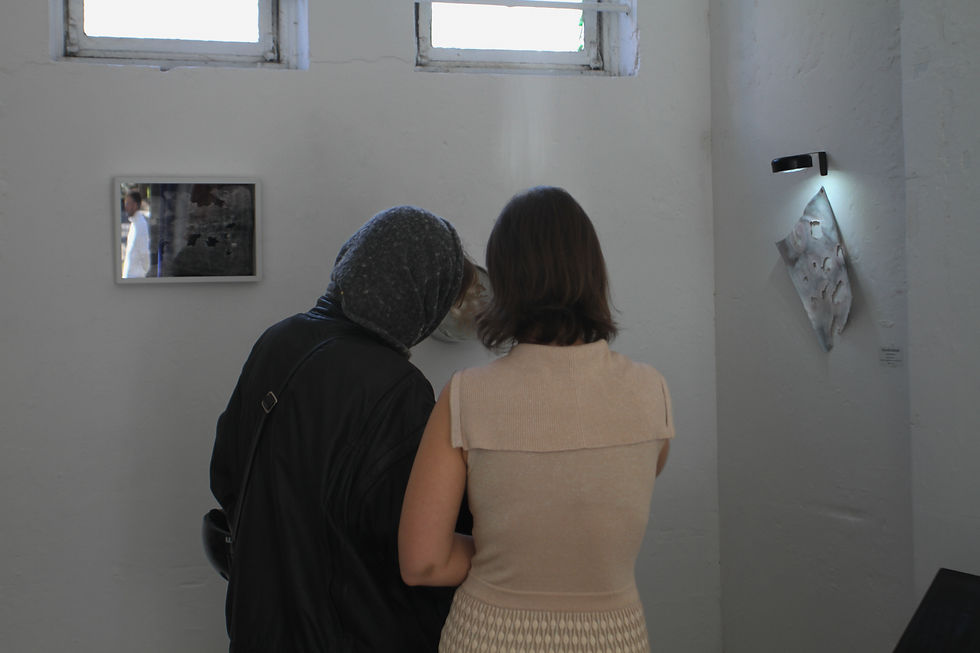
The first time I saw the space I wished to exhibit in that corner, because of the specifics of the works, I did not want bright lighting and wanted to create a sense of darkness.
I exhibited 4 artworks: two paintings and two installations with macrame, textile and mirrors.
The mirror itself should not be visible at first glance; only after careful observation can visitors notice the reflections. It reveals their presence in the whole ambience and gives a chance to become part of this open-ended dialogue with mycelium and with themselves.

Your approach to art stems from collaboration and environmental consciousness. How do you feel art can create a message or even act as an agent of change in today's world?
Art teaches us to be open to others’ worlds, to accept different points of view, to stay with questions that appear once you see the artwork or even later.
Art is not about complete clarity; it serves as a guide to the inner processes of creativity.
To understand things which may look strange and you may disagree with, you have to let this otherness exist even without comprehension. It can provoke changes in your perspective. This is an important step towards initiating collaboration and any form of change in personal or collective behavior.

If you could give one piece of advice to future participants of this programme, what would it be?
Be open to any experiments and follow your passion. The key here is questions, not answers.
Find more about the artist here.
Cover image:
Silence in round, 2026. Aluminium sieve, mirror, textile, mycelium. 9cm x Ø18cm. Image courtesy of the artist.

You May Also Like
.jpg)
Art in Context: Kamila Szejnoch on Site, Memory, and Public Space

The Algorithmic Gardens of Guo Cheng

Eight Meters of Silence: Bahar Talebi Najafabadi on Rejecting Didacticism in Contemporary Painting

Confronting Consensus Reality: Philip Ringler on Conceptual Photography and Cultural Critique